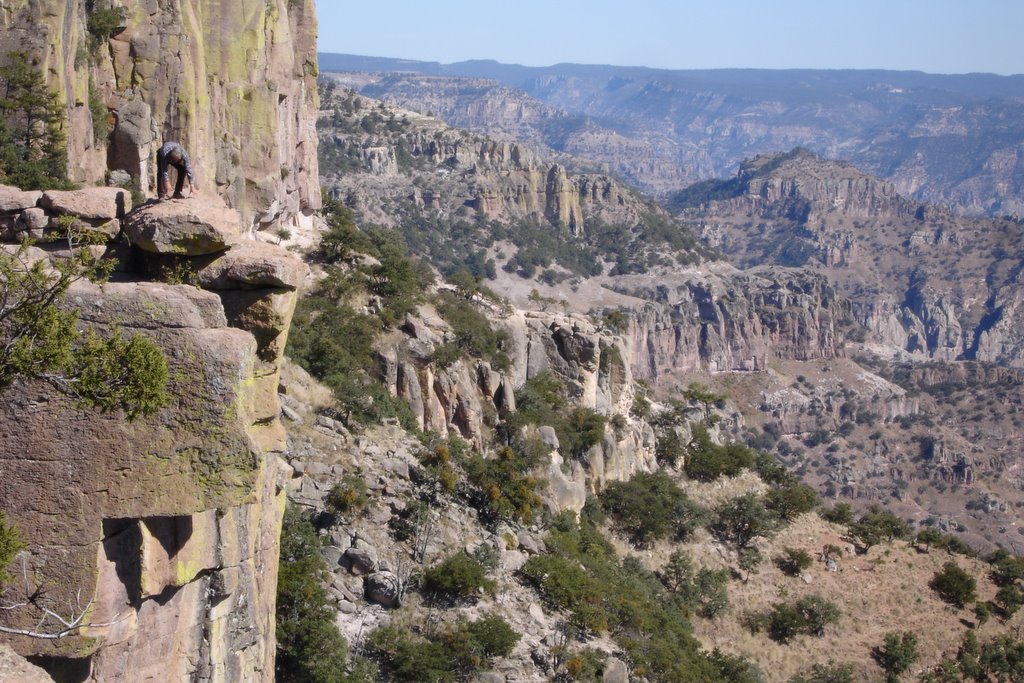
I See Dead People
City of culture, city of live music, sweeping hills and ornate monuments. But let`s get straight to the point - Guanajuato is perhaps most memorable for its dead.

High up on the outskirts of central Guanajuato is Mexico´s strangest tourist attraction - El Museo de las Momias. It`s also one of the most popular if the long lines of wide eyed visitors present on the day I visited are anything to go by.
The Museum houses the remains of over 100 of the city´s citizens exhumed from the local graveyard between 1865 and 1979. Mexican law used to state that if death dues were not paid in full within a few years of your death your body would be dug up from the ground to make space for a wealthier neighbour. When they started doing this in Guanajuato they noticed an odd thing - the bodies were coming back preserved - it seems the ground contains the perfect chemical mix.
Now at this point you might think cremation would be an option, or at the very most a brief scientific investigation before the bodies were disposed. But this being Mexico, with its unique `relationship` with death, someone saw a gap in the market and got to work.
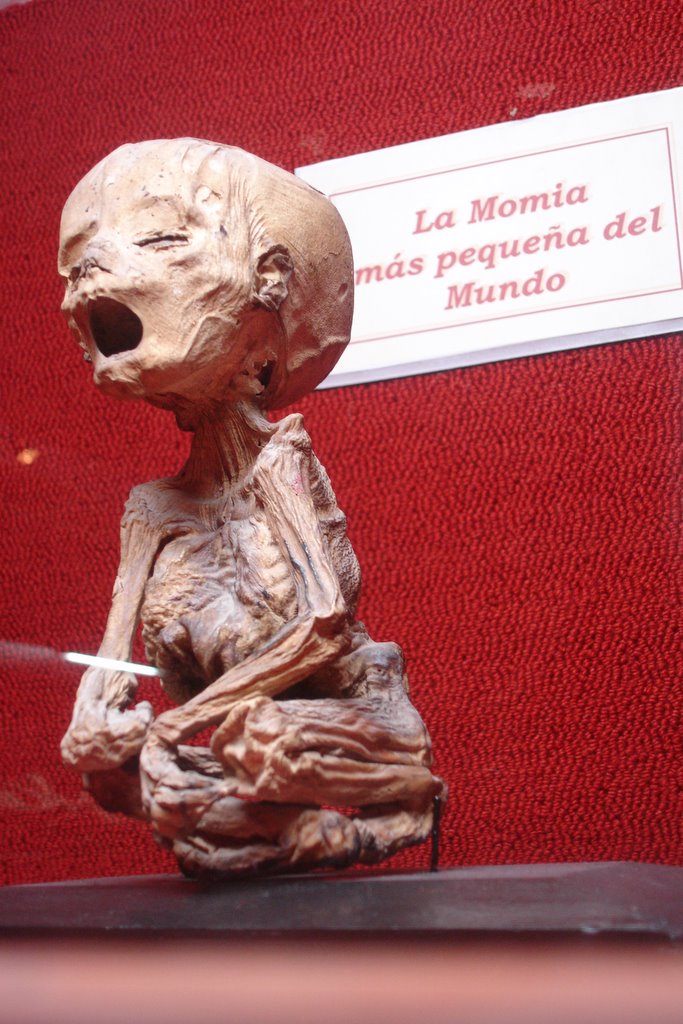
The bodies were originally stacked alongside each other, the dead heavily pregnant woman alongside what`s supposed to be the world`s smallest mummy, but there were complaints. Shocked tourists (mainly Americans) petitioned everyone from the President to the Pope to tackle this outrage. The upshot is that the bodies are now laid behind flexiglass screens allowing the thousands of visiting schoolkids to press their faces right up against the relatively recent dead.
The upgrade also had the beneficial side effect of stopping tourists breaking off the odd finger or toe to take back as a souvenir. We`re talking about fresh levels of sickness here.
It`s a really bizarre experience. The sheer number of corpses is pretty shocking. Perhaps most affecting of all is how the hair remains - not just on skin slowly peeling off skulls, but as small curls working their way up petrified legs - and in many cases covering long dessicated genitals.
Oh yes, there´s no shame here. Not only do the deceased go on show for eternity, but their shrivelled up bits are exposed in their full glory under the installed spotlights and flashes of the countless cameras recording the shame for perusal back at home.
While all this is fascinating for the first fifteen or so minutes it does start to get a bit stuffy and the novelty wears off surprisingly fast - even when the organisers decide to shake things up by pasting up before-pictures of the bodies freshly lying in their coffins for comparison with the after-reality staring back at you.
The weird thing is that once back in the fresh air and bustling streets I started to look at some of the aged, crooked denizens of the city as they shuffled along the historic centre and realised several looked little healthier than their cousins on display nearby.
One more story about the museum before I move on - when I arrived there was a huge queue of Mexicans by the box office which, being a Brit, I naturally joined without question. It was only 20mins later that a member of staff spotted me and pointed out they were waiting to enter as part of a group tour and I could get my ticket straight away at a second till. The irony is that the group was made up of senior students from a nearby Tourism Academy - and not one had thought to point out my obvious error.
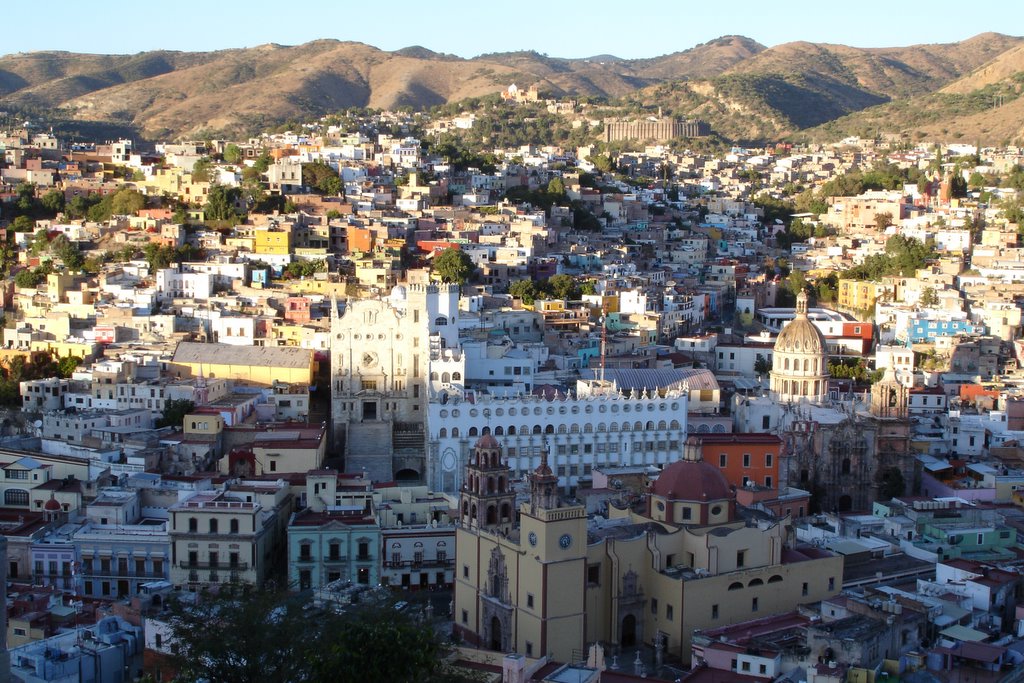
Gunajuato itself is very much a living vibrant city. It houses one of Mexico`s top universities and its students ensure a wide selection of bars, cheap restaurants, internet cafes and live/dance music in the evenings. The city has also started to attract rich American retirees who want to enjoy both the Mexican cheap cost of living and its culture. One couple I spoke to explained they had moved to the city rather than nearby San Miguel Allende because the latter was now overpacked with Republicans. (As a sidenote it`s interesting how US Americans nearly always strongly identify themselves by political affiliation in a way most Europeans never would).
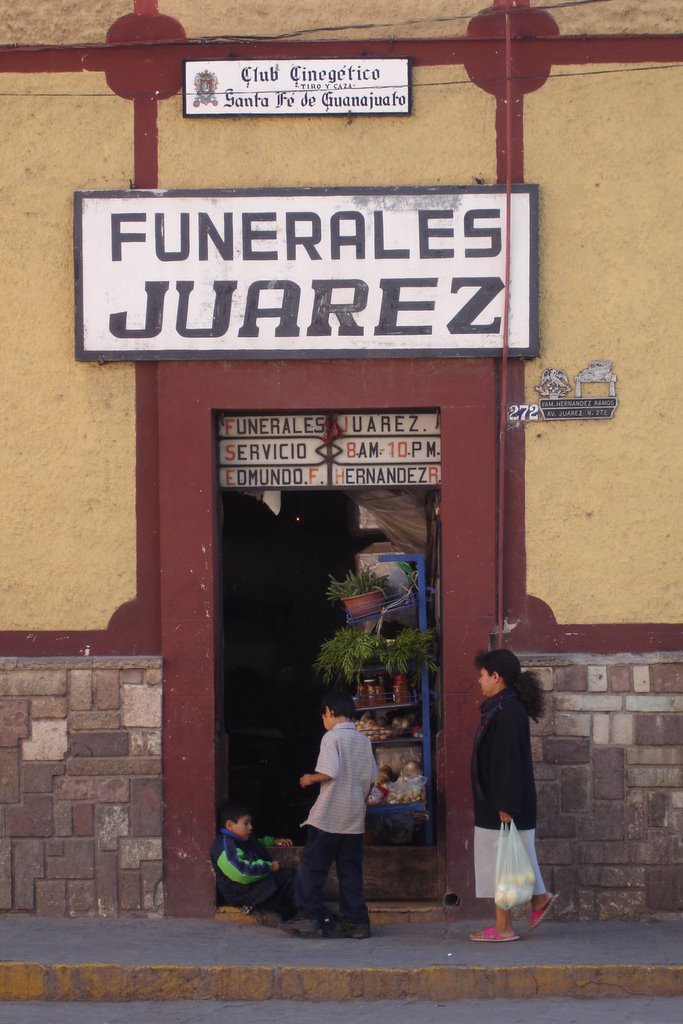
I could take a cheap shot at how this fresh wave of immigration will undoubtedly benefit the city`s death trade, but it would be too easy. Instead I`ll simply remark that the city´s funeral parlour looked in good nick and was stacked full of freshly carved coffins when I peeked my head through the door.
Actually pretty much all of Guanajuato looked in good order. Much of the reason is that like Zacatecas it houses a thriving silver mining industry. There´s the possibility of visiting the nearby mine - but unlike Zacatecas you can´t go down into the ground and since it`s a few kilometres out I didn´t bother making the trek.
Instead on my first day´s explore I was attracted to the home of another dead man -

Diego Riviera. Outside Mexico the artist may now be better know as the husband of Frida Kahlo, but here he´s still recognised as the country´s most accomplished artist. Originally he was shunned by the wealthy leaders of Guanajuato because of his communist leanings, but I guess fame has a way of sorting things out.
I´d tried to see his murals in Mexico City and some of his work held in a Zacatecas museum but both attempts had failed as the buildings were closed when I´d arrived.
I knew from the LP that his childhood home housed some of his drawings and paintings, including the above sketch of Frida, as well as others of his lovers. But I didn´t expect the selection to be such a varied mix of styles.
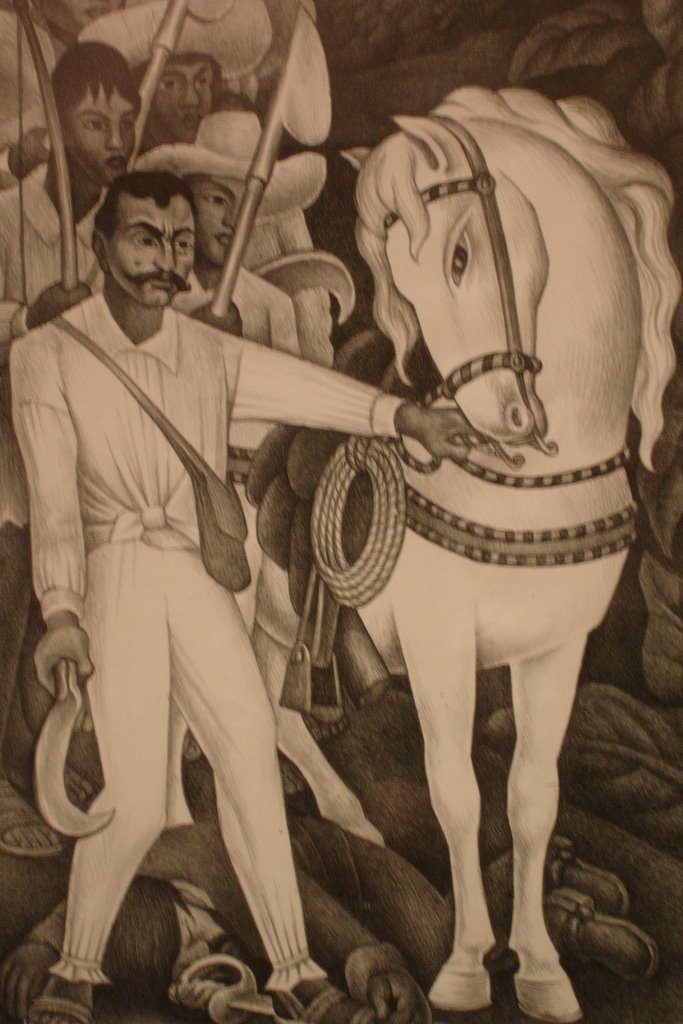
There`s everything from historical detailed drawings to large Picasso-inspired oils, brightly coloured indigenous-styled art, landscapes and small outline sketches of his famous giant murals. Filling up the upper floors of the (very impressive) house I was left in no doubt that he was hugely talented at every mode of art he applied himself to. Or maybe they just don´t display his shit work ;)
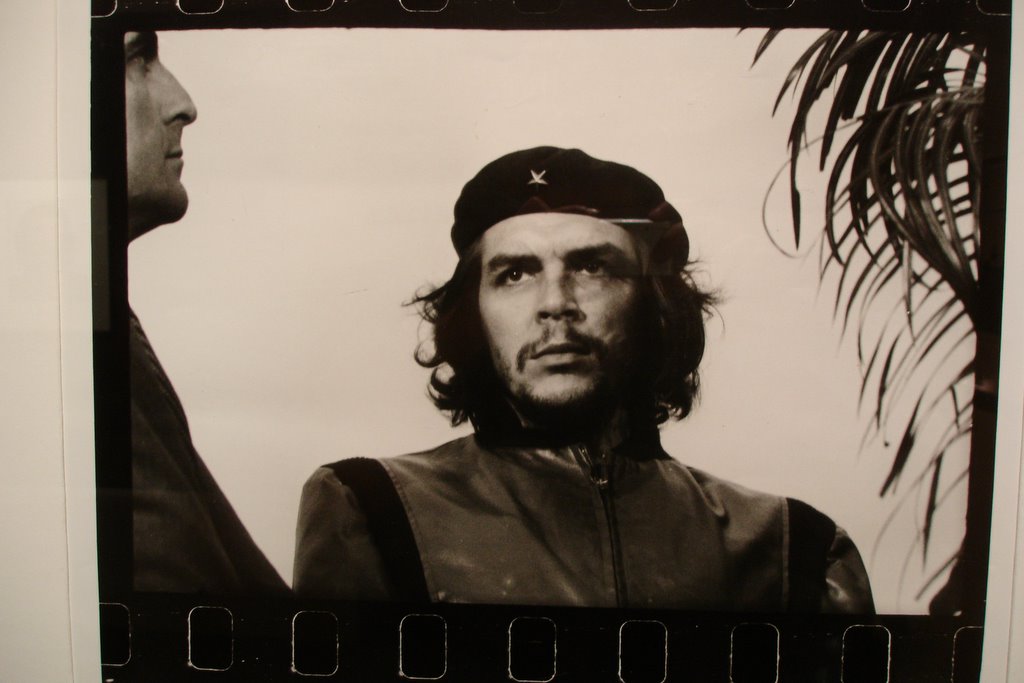
As an added bonus at the top floor of the frankly HUGE house there was an exhibition of photos by Alberto Korda of Che Guevara and Castro including ´that´ picture, which the exhibition modestly described as ´the most famous photo in the world´. What caught my attention is that the original picture wasn´t the close up of Che´s face that we´re so familiar with, but Korda had tried to be arty and frame Che with a second figure. I sneaked a quick picture when the guards weren`t looking and have included it alongside so you can see for yourselves (click to enlarge it).

I spent most of the rest of the first daytime just getting my bearings. The main part historic centre is actually pretty easy to navigate - one main road winds past museums, shops, churches and markets with smaller roads and plazas shooting off hiding numerous bars, cafes and fountains. But venture far beyond and it's easy to get lost in a maze of thin steep alleyways. The free map handed out by the tourist board (on Calle Obregon) isn't much help. It looks very pretty - a tangle of multicoloured strings that faintly resemble a few of the main roads - but doesn't even attempt to tackle the rest of the town. But if you have the time it's well worth letting yourself get lost and then working your way back by spotting the main monuments as they appear through the spaces between the buildings.
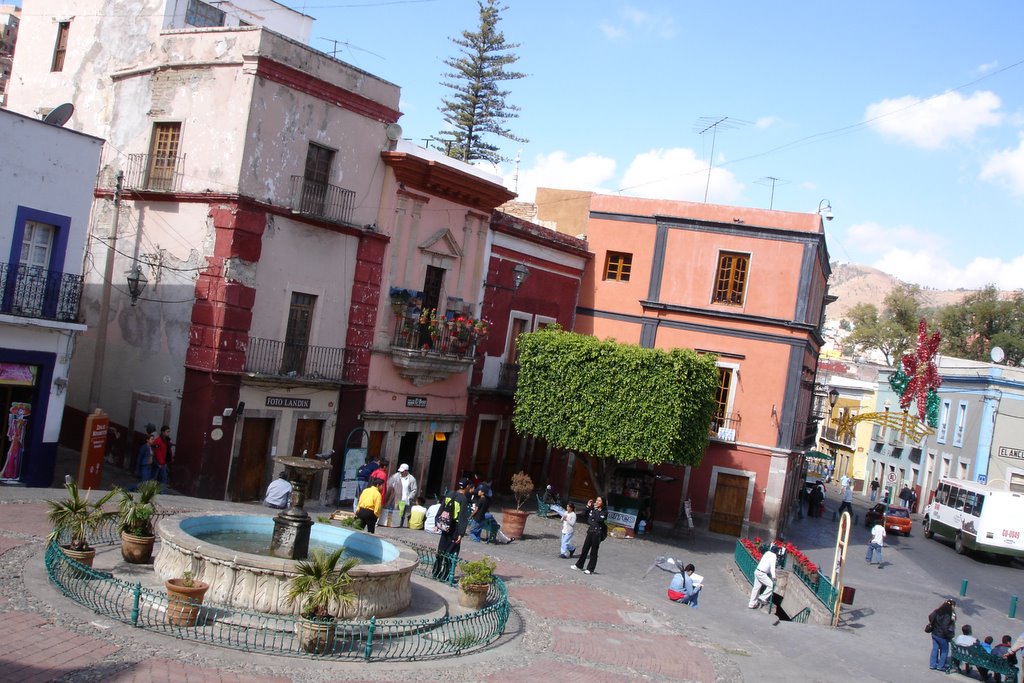
One of the weird things for me was seeing the newly placed Christmas decorations sparkle in the sunlight. I'm used to seeing the festive frills dripping with rainwater, only glinting as they reflect streetlamp light or car headlights. All that glitter in the bright warm sunlight somehow just seemed wrong.
One more strange thing I never got to the root of was a couple of guys who would wander up and down the streets ringing a huge bell. No-one seemed to pay them any attention and there really didn't seem to be any purpose to it. Every now and then they'd stop, have a sit down and a rest, and then start their ringing wandering again. If you know what that was all about please enlighten me.
By about 6pm it was time to cut short my own wanderings. The city centre's water supply had been temporarily suspended for maintenance work and after my long overnight journey I was quite keen to grab a shower before the evening. The plan was also to try to meet others at Hostalito Guanajuato where I was staying, but for once my luck seems to have run out. There was no-one else downstairs in the reception area and bizarrely the hostel's advertised terrace area was only accessible through one of the locked dorm rooms.

I didn't have time to hang around hoping to meet other travellers anyway as I'd earlier bought a ticket to see a flamenco show at Teatro Juarez. The theatre is a spectacle itself. Dating back to the early 20th century it's imposing entrance gives way to a spacious lobby filled with stained glass panels and gleaming floors. The walls of the theatre itself are covered with complicated carved Moorish patterns painted a deep red and gold. I got chatting to a softly spoken Chinese American woman who sat next to me and we easily filled the time before the performance talking about the intricate and no doubt costly decorations. The benefits of living in a silver city again were obvious.
I'd guess the majority of the audience were foreigners - it was probably the first time I'd been surrounded by so non-Mexicans since arriving. So it's hard to know whether the barrage of flash photographs that accompanied each costume change is normally acceptable in Mexican theatre. Certainly it seemed allowed and didn't faze the musicians and dancers. Though I've seen better flamenco in Sevilla the company's standard was high - especially the principle dancer/choreographer who stole every scene she was in.
By this point the streets were thronging with people attracted by the variety of Saturday nightlife. Normally I'd have been attracted to one of the nightclubs, but was feeling in a mellow mood after the show and instead opted for a trova bar. Trova is basically a singer-songwriter music, often one man (and it is usually a guy) a guitar and a songbook. Think early Billy Joel, Damien Rice or even a laidback Bob Dylan. This place was packed both with young couples and older groups chilling out to songs by Silvio Rodriguez, Pablo Milanes and others over the candlelight. Very cool - and I found myself staying for one more song, then one more and another before I was finally left with just enough energy to stagger the 10-15 minutes back to my bed.

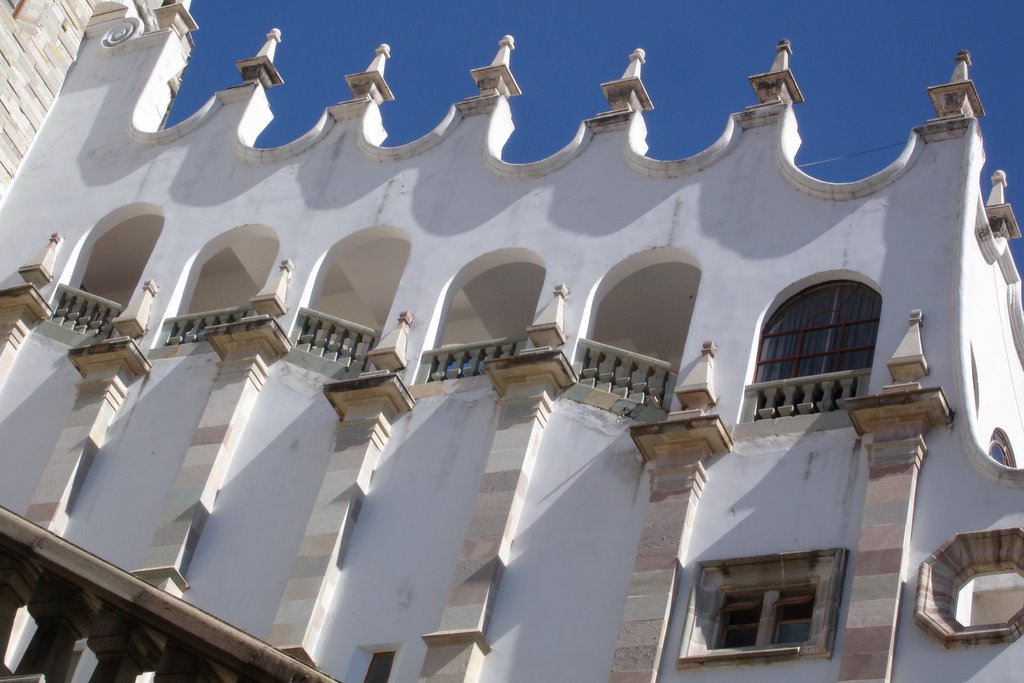
One of the joys of Guanajauto is it is so damned photographable. I'd originally planned to spend my second day taking a day tour to nearby San Miguel de Allende and Dolores de Hidalgo but changed my mind en route to the pick up point preferring to spend the day snapping coloured monuments framed by narrow alleys and playing with the exposure settings on my camera to capture the wide array of architecture.
Throughout the day I had the nagging sensation that Guanajuato reminded me of somewhere else. Finally I twigged - it's Mexico's sunnier sister city to historic Edinburgh. If you've visited Scotland and are scratching your head hang with me a second here and I''ll try to explain...
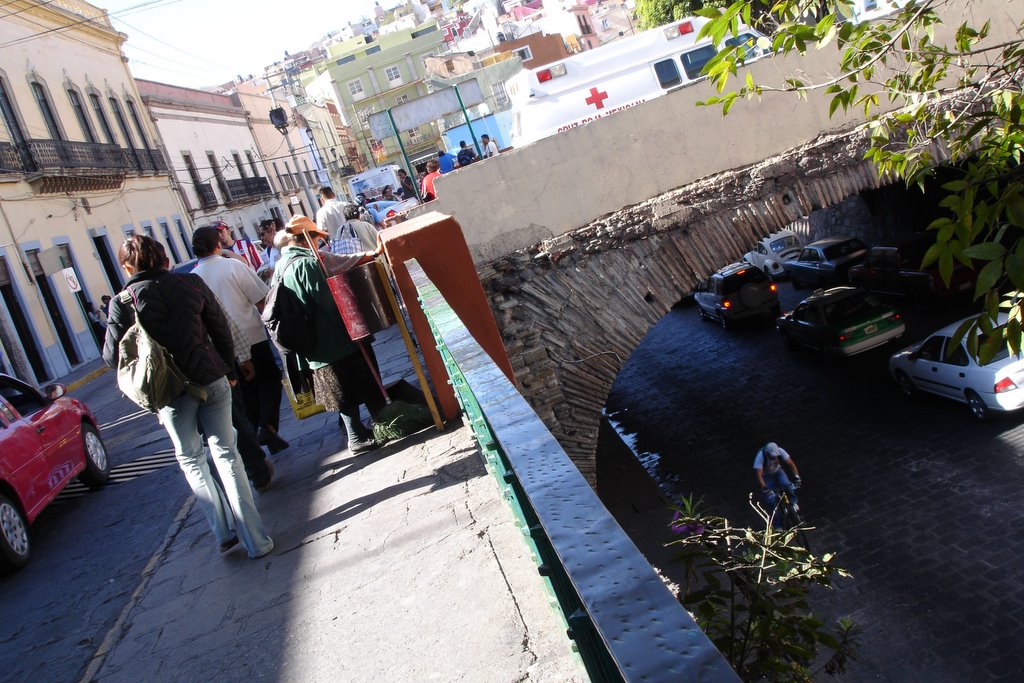
A large river originally flowed through the middle of Guanajuato, but was diverted in 1905. The water's path has now been converted into a large underground roadway off which several tunnels have been built to keep traffic away from the mainly pedestrianised city centre. This means the city effectively operates on two levels with stairways punctuating pavements allowing its citizens to descend into the gloomy smelly depths. The effect is much like Edinburgh's multi-layered Old Town leaving both cities a pleasure to walk round, but a nightmare to drive.
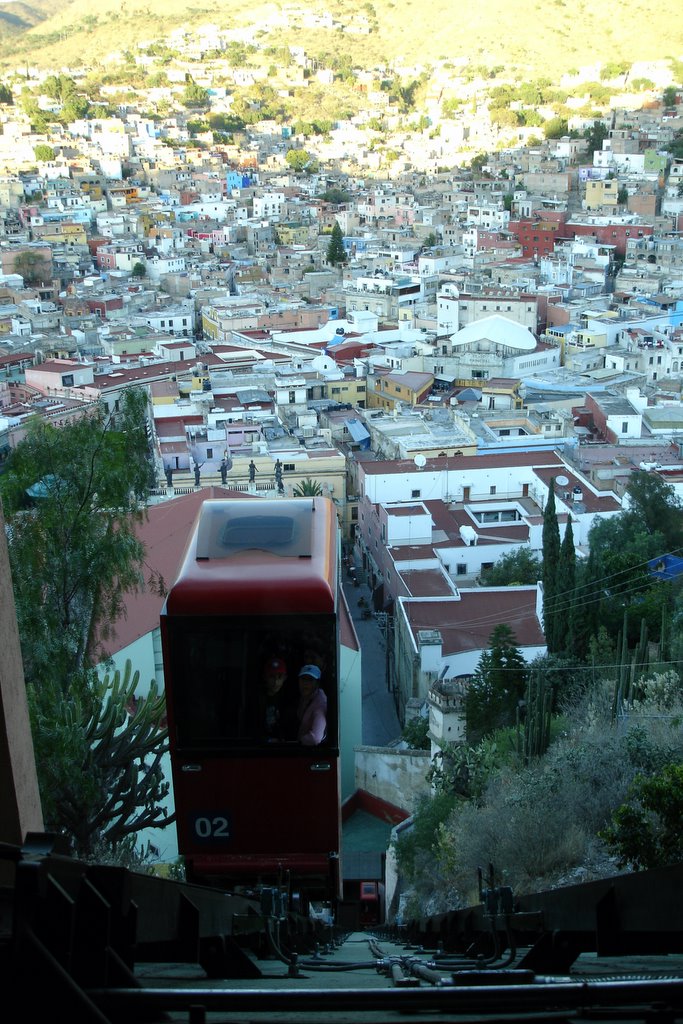
They also both seem to have the impossible feature of having more up hills than down hills. But Guanajuato has a trick up it's sleeve - or at least up its steepest hillside: A tiny Funicular which carries grateful passengers up to crazily steep incline. I shared the cabin with a group of touring school children. Looking down at the coiled metal cable dragging us shuddering to the top the teacher kept his class amused by speculating about the chances of it snapping under our weight. The operator's stoneyfaced look was the only reassurance this wasn't a headline waiting to be published.
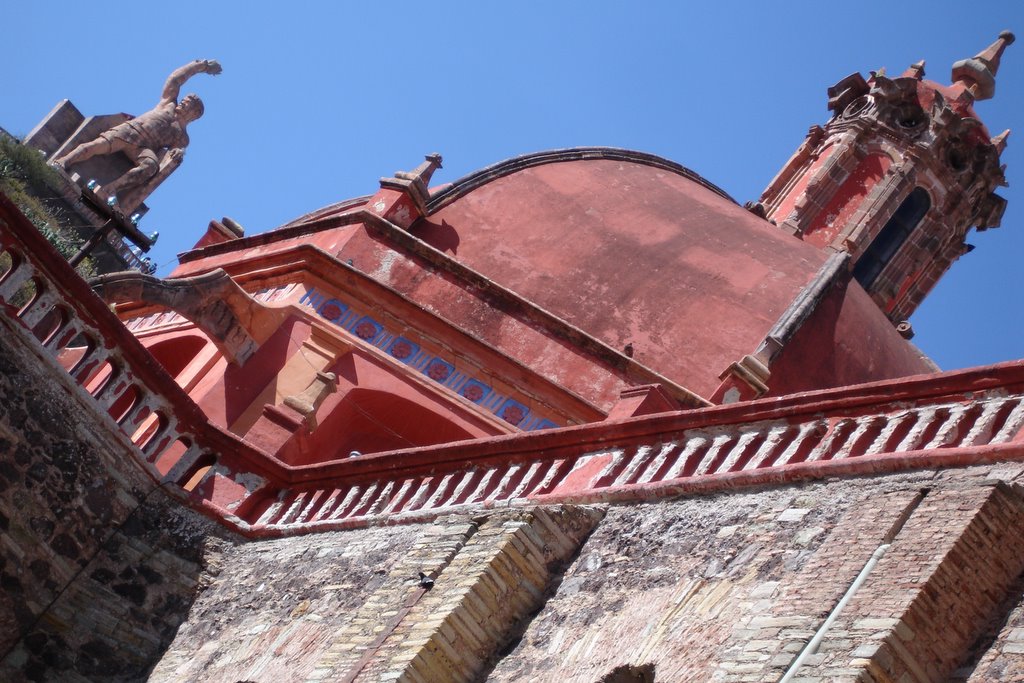
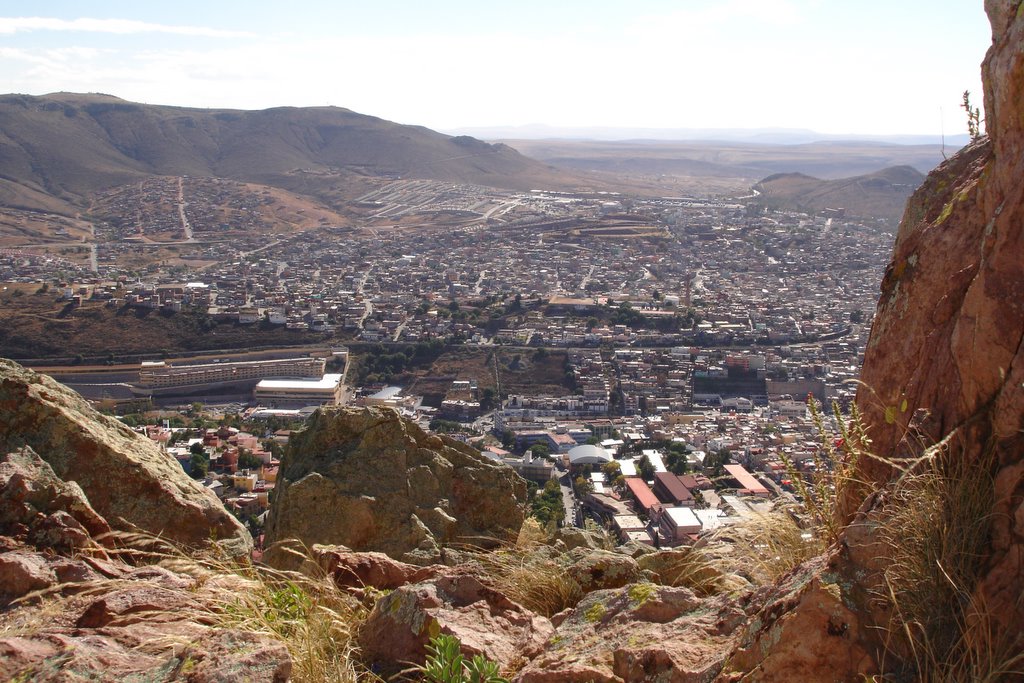
The view from the top was spectacular - and is shown at the top of the entry. But it vies for attention with another dead man who dominates the city - El Pipla (visible in the photo in the top right corner if you click and expand it). The story goes that in 1810, during the Mexican War of Independence, his actions gave the rebel army its first victory. The Spanish had holed up in the city's grain storehouse and seemed to be in good position to hold out against the 20,000 Mexicans until help arrived. Bu the rebel leader, Miguel Hidalgo, had a plan. He ordered a young miner (El Pipla) to tie a huge stone slab to his back and use it as a shield against the Spanish bullets. El Pipla was then able to walk up to the store's gates, set them alight and cook the Spaniards inside. Legend says he lived to a ripe old age - which is more than can be said for Hidalgo and the other three rebel leaders. They were captured a year later and their severed heads were left rotting on display at the site for a decade.
These days you can walk up to the top of the statue if you pay a couple of pesos. But to be honest the view is little different from the one from the viewing platform at its base.
One other dead guy haunts the city - Cervantes and in particular his creation Don Quixote. Every year the city holds the 2-3 week long Festival Internacional Cervantino at the end of October which is widely regarded as one of the cultural highlights of Latin America. Musicians, actors, artists and dancers come from all over the world to perform and accommodation becomes near impossible to find and significantly more expensive. Just like Edinburgh's own summer festival (see another link!).
But even over the other 50-odd weeks of the year it's hard to avoid the Spanish author's influence. A huge bronze statue dominates a coutyard at one end of the historic centre, there the wonderful (and free) Museo Iconografico Del Qiojote containing the mad knight and his companion Sancho Panza depicted in paint, scultpure, glass and china by a dazzling range of artists. Plazas, bars and shops are named after Cervantes and the local university bestows its own Nobel prize to scholars who have specialised in his works - no prizes for guessing what the medal is called. In the evenings as the locals gather to listen to musicians playing music round the Jardin de la Union painters display their newly painted fantasies of Quioxte and Panza wandering through Guanajuato. The link between the city, the author and his character may only date back about 55 years but it's hard to think of a place so entwined with literary figures. All the more strange when you remember that Mexican nationalism is often in part based on a rejection of Spanish roots.
More details about the festivall can be found at:
Festival Cervantino 
So what else is worth doing in town? Well the Mercado Hidalgo is the big draw if you want to see an old style indoor Mexican market at work. Small food stalls offer super fresh lunches, clothes are sold on the cheap and there's more choice and value available than Walmart could offer in their dreams. Just outside is the place to pick up CDs and DVDs with photocopied covers and discs of dubious origin - if they jump when played don't even dream of sending them back to the manufacturer. And as can be seen above, there's every flavour of sauce available so long as you're looking for chilli (sorry - couldn't resist).
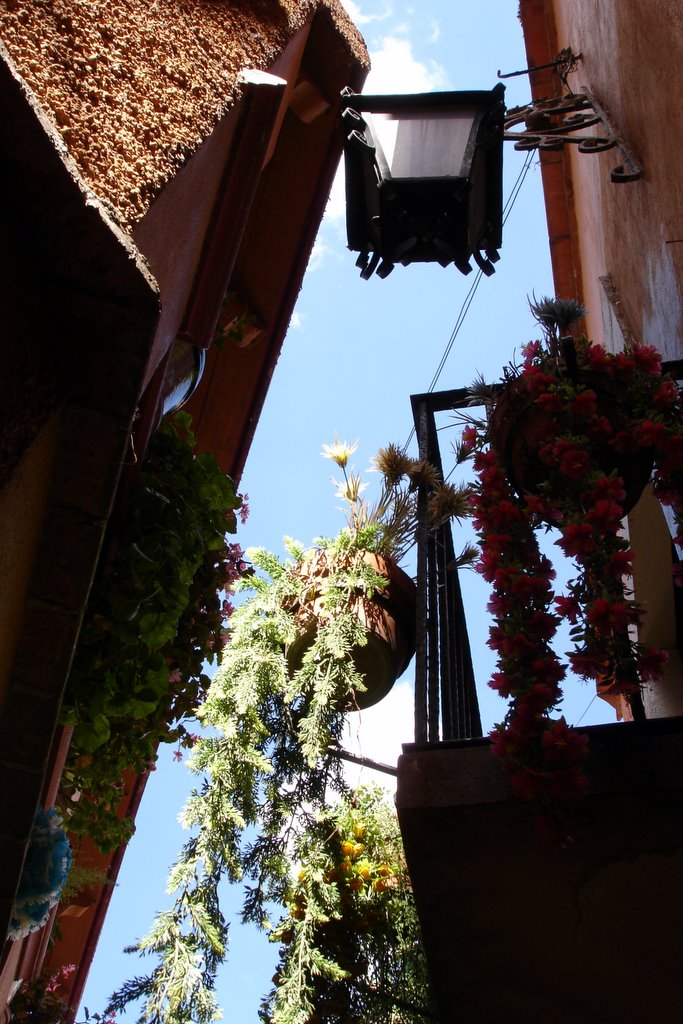
A five minute walk away, just off Plazuela de Los Angeles, Callejon del Beso is also worth a quick visit. Undoubtedly the narrowest walkway I've ever squeezed through, the Alley of the Kiss is famous for the balconies above which almost touch each other. The story goes that centuries ago Doña Carmen, the daughter of a rich but violent man lived in one of the houses. She fell in love with a local lad named Don Luis who courted her by offering her holy water from the local church - what a smoothie. Anyway the dad found out and flew into a rage - threatening to send Carmen to a convent in Spain and locked her up in her room. When Luis found out he bought the house opposite for a small fortune and continued to court Carmen over the balconies which were narrow enough for the two to steal illicit embraces. This being Mexico the story couldn't have a happy ending - the father discovered the deception and stormed into Carmen's room where he plunged a dagger into his unfaithful daughter's heart. She died. Luis was so shocked he kissed the lifeless hand of his love and then killed himself. So Mexico's very own Romeo and Juliet and more dead people to add to the city's bulging list of legends.
For a place I stayed such a short time there's been a lot to write and remember about Guanajuato. In a way not meeting another group of friends made it easier to pack so much in and use most of the afternoon of my last day to update the blog. Sunday evening was a big contrast to Saturday with many bars closed and the streets very quiet. A very bad trova singer was playing in La Oreja de Van Gogh bar so I came back early to the hostel to make use of the free high speed internet.
For anyone considering staying at the hostel it is fairly close to the centre, has a big bar and kitchen area and very friendly staff. My private room was large and clean although there wasn't the option of an ensuite bathroom. Had there been a few more travellers it would have been a perfect base - guess I just picked the downtime.
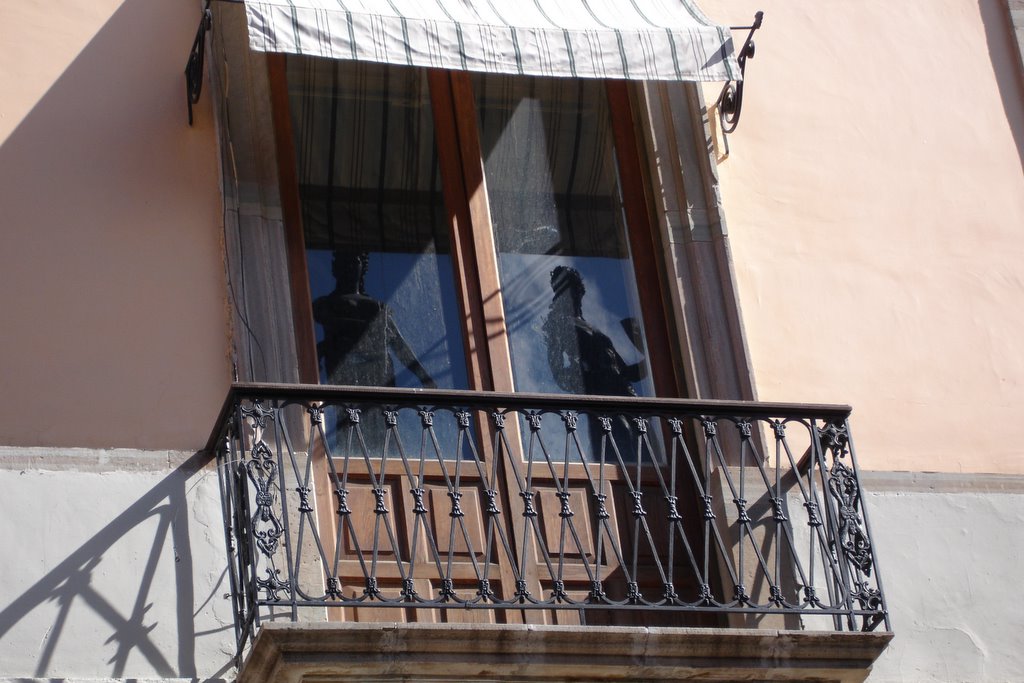
I arrived in Guanajuato tired and after an initial wander was ready to be disappointed after the pleasures of Zacatecas. But the city really grew on me, both through its colourful tales and its rich visual wealth. Of all the places I visited in Mexico it's here I most wished I had a proper large lens SLR camera. If you're passing through this way it's well worth sparing at least a couple of days and a few hundred megabytes of memory card.
Guanajuato - it's dead good.
Deep Down in Silver City

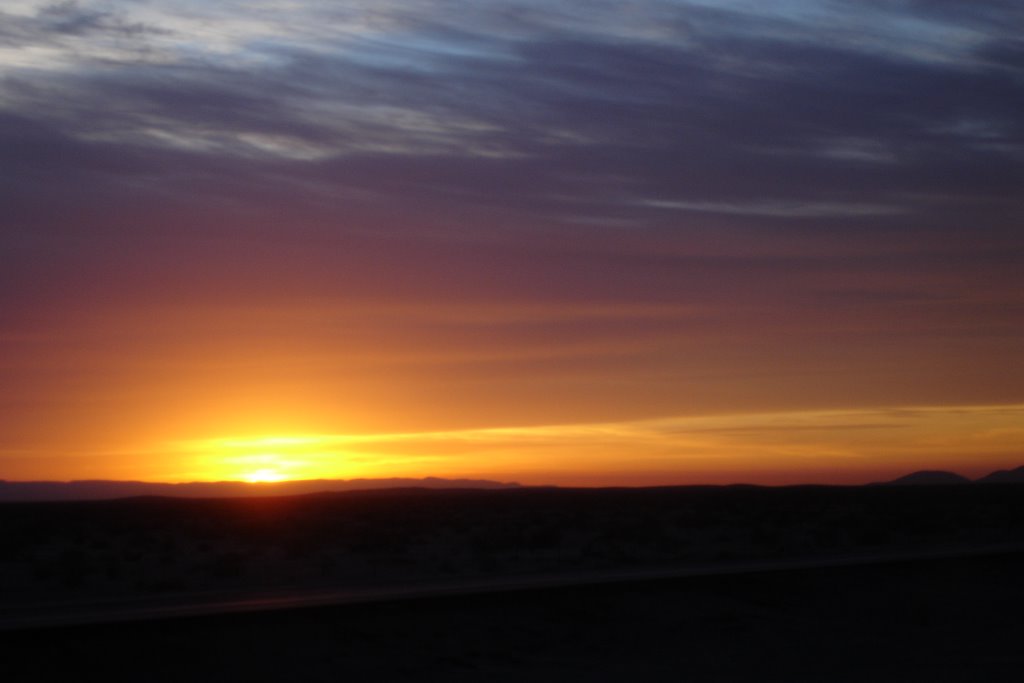
I knew things were getting desperate when I realised I was laughing out loud at an American comedy that was so ´good´ it was never released on dvd, let alone the cinema, in the UK. The film was Repli-Kate (university student clones cute girl by mistake, teaches it how to behave only to discover he´s created a sex-addict beer swilling beauty - and he prefers the original.... OK I´ll stop right there). By this point I´d been travelling for approximately 20 hours including a few hours stop-off at Chihuahua bus station. I´m still not sure if the film is an undiscovered gem or whether my brain had started to short circuit. The only other stimulation it had had in the previous few hours was a stunning sunrise over the Mexican desert and some truly tragic Mexican music blaring out of the driver´s stereo a couple of rows in front of me.

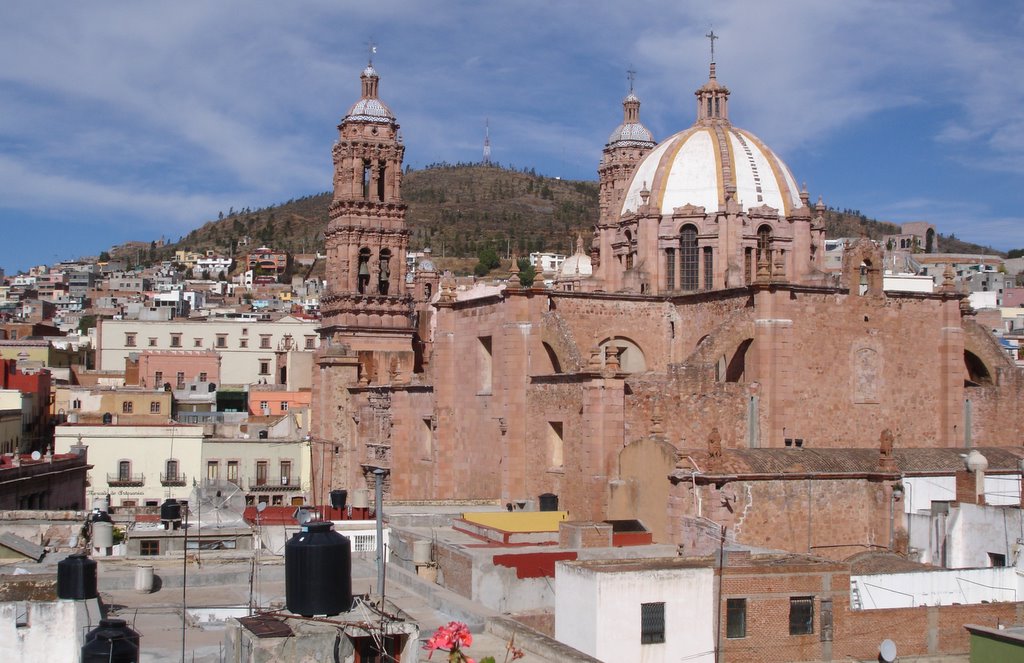
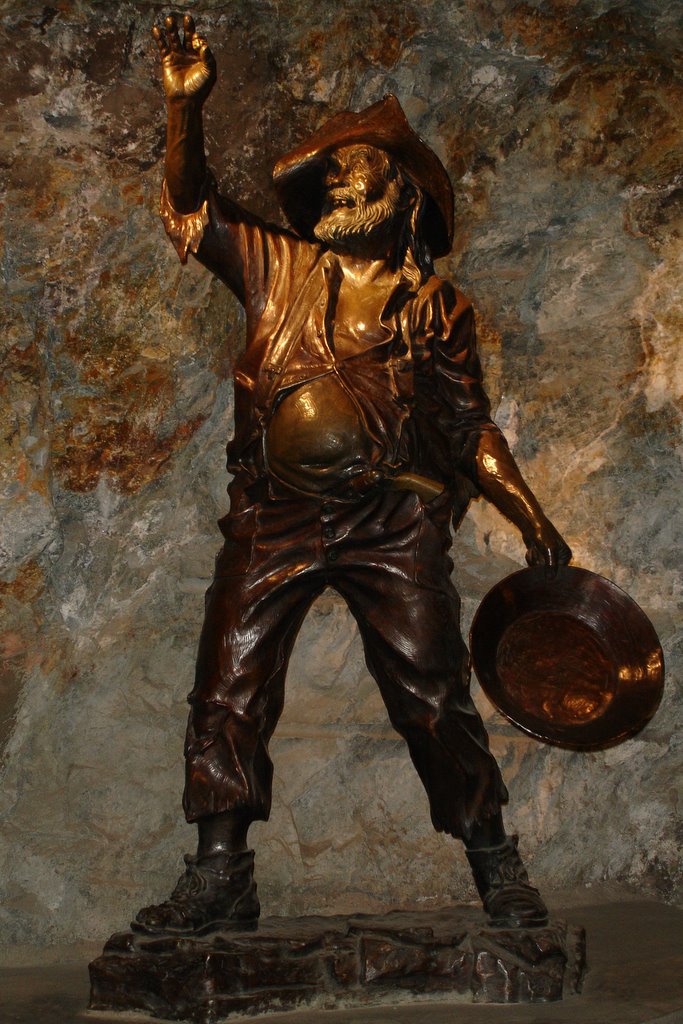
Eventually the bus pulled into its destination - Zacatecas, Mexico's elegant and prosperous city of silver. The city´s existence came about by what was undoubtedly a regretable action. One of the local Chichimec tribesmen gave a Spanish conquistador a piece of the precious metal sparking off a search for its source. The Basque Juan de Tolosa found the vein in the Zacatecas mountains in 1546 and two years later the city was settled. At one point more than fifty silver mines were in operation and the Spanish had to import African slaves as they´d run out of Indians to work the shafts.
The city was temporarily New Spain´s third largest city and the legacy is a very Spanish city with wide streets, ornate architecture and a bustling sense of fun. Unlike most of the places I´d been so far the city looked well cared for - pavements and roads in good order and a good selection of consumer goods on sale in the city centre. The locals also looked very Spanish, dressed in the latest fashions and much paler than their Eastern cousins. However those I spoke to strongly identified themselves with Mexican rather than Spanish roots and showed more interest in the idea of visiting London than Madrid.

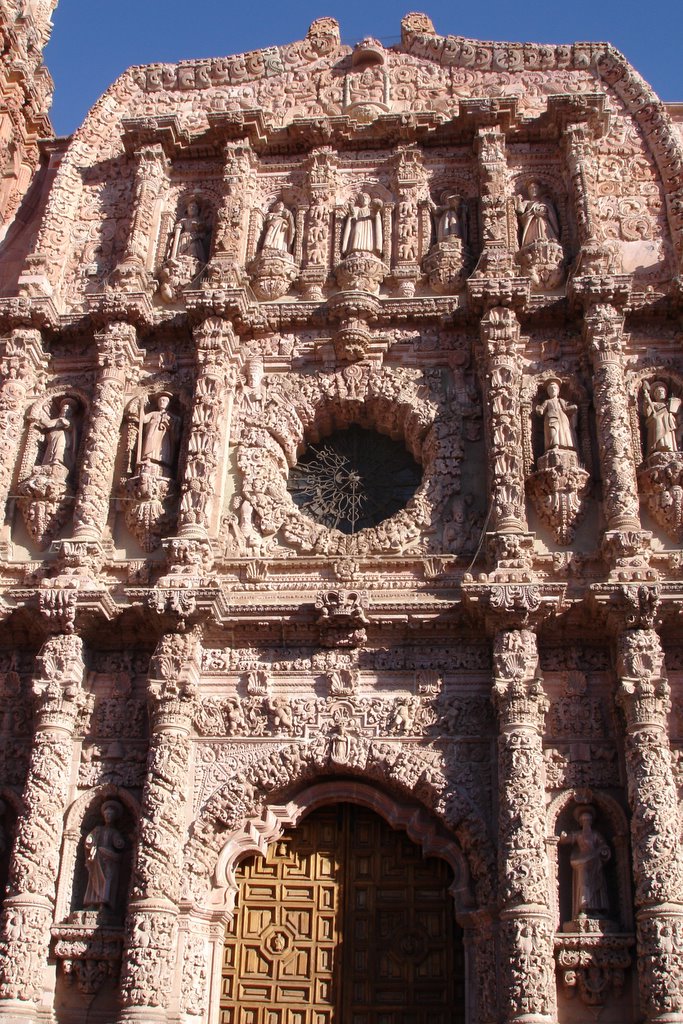
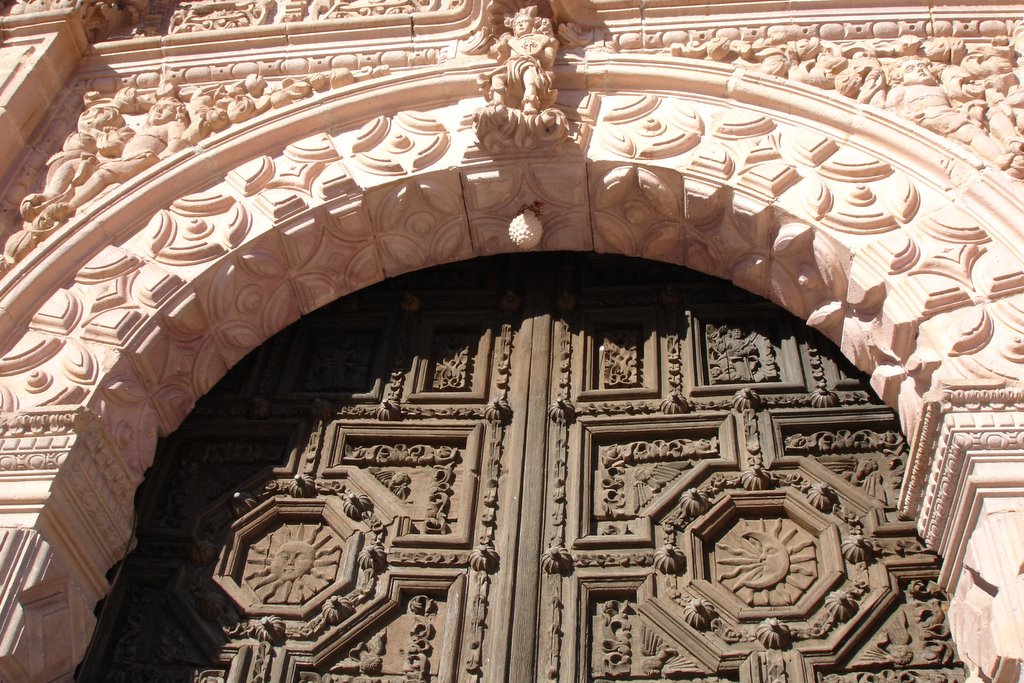
At the city´s centre is a pink stoned cathedral with incredibly intricate baroque carvings on the outside walls, although inside the decoration was quite plain. I guess the merchants were too busy sending the silver south to Mexico city to spare any to decorate the walls.
Curiously I noted on the building´s side entrance the sun and moon had been carved into the woodwork. These were the symbols of the indigenous Indian´s gods and have become mixed up with Catholic symbolism - even so I was surprised to see them appear so blatantly.
Having arrived later afternoon I had little time (or energy) for sightseeing on the first day and instead spent my time converting photos to cd and buying my flight to the Yucatan peninsular for later in the week.

After buying the ticket I asked the Mexicana sales assistant if she could tell me where I could get a haircut. "¿Quiere que te lleve?" she asked. "Si, gracias" I replied - I´d just been offered a lift!
Velvet´s car was parked 10mins down the street so I had a good opportunity to try out my Spanish and though the conversation was fairly basic - no discussions about quantum mechanics - I seemed to manage OK. Good job Solexico/Rosa and Patricia (my Edinburgh Spanish teachers)!
Soon I´d been dropped off outside a Mexican barbers shop. Sitting down I watched the barber shear his customers close to the skull as Mr Bean played on his portable television. What had I let myself in for? As the people in the queue in front of me dwindled I saw him slash his blade across a strip to sharpen it at the end of each cut before scraping away any errant hairs on the back of their necks. Luckily the Spanish paid off again and I managed to explain what I wanted and ended up with a pretty stylish looking tidy-up rather than the skinhead I feared. The price was 35 pesos (approx 1pound fifty/three dollars)- around ten percent of the cost back home. Of course I left a health tip.
On leaving I realised I had absolutely no idea where I was, but after a fifteen minute wander found myself back at the hostel door after a quick trip to one of the local cd shops. I´m going to write a seperate chapter on music later on but there´s some brilliant Mexican rock music that I´d never heard of even after so many trips to Spain.

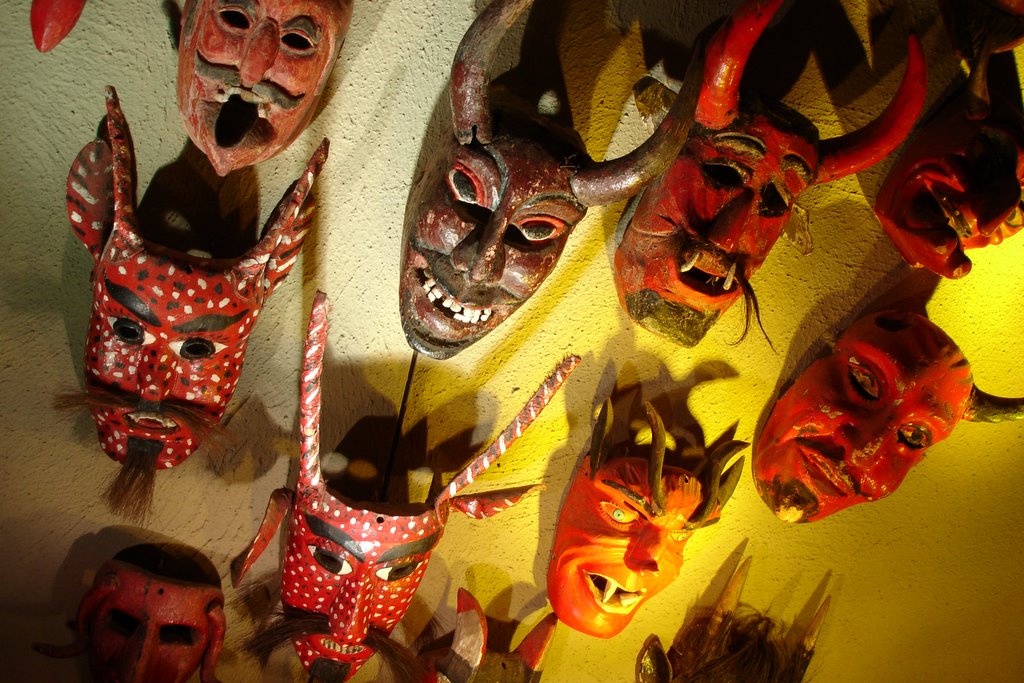
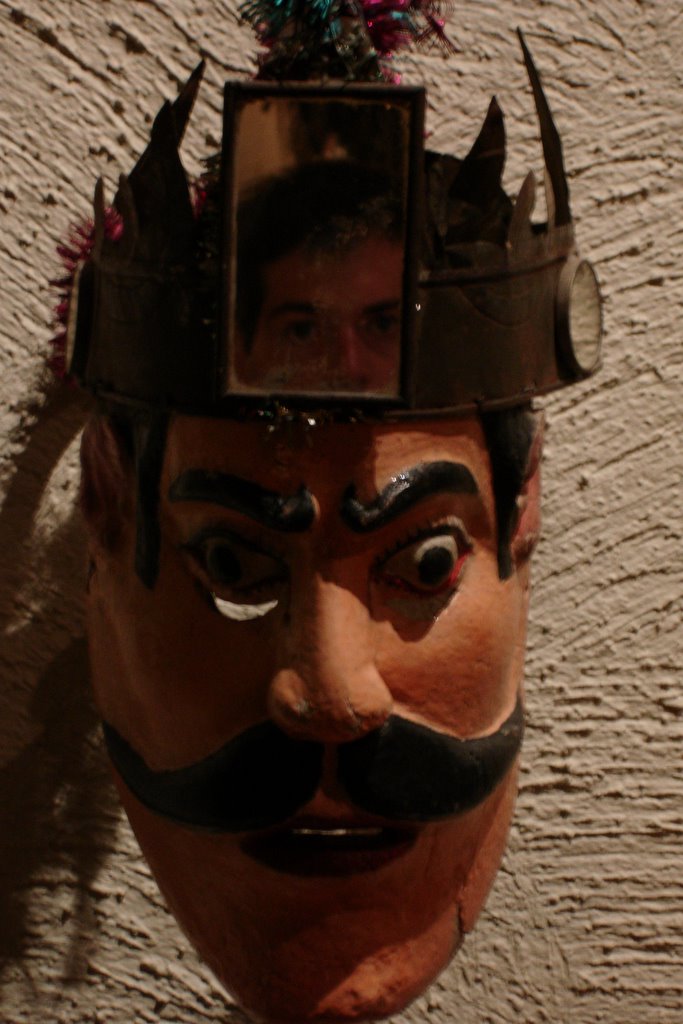
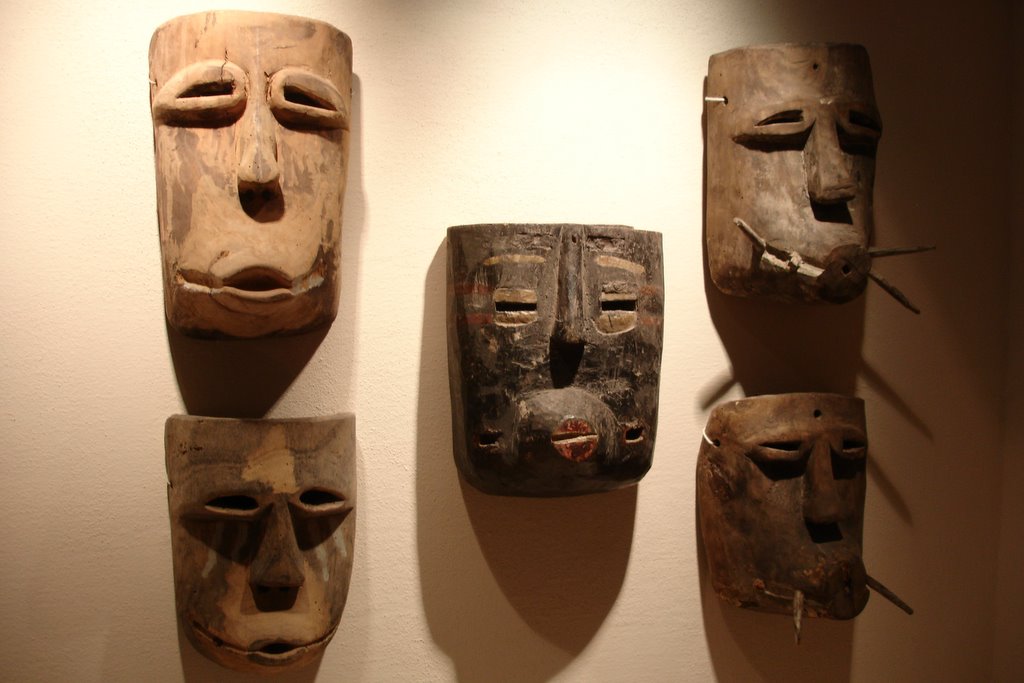
Rested and refreshed I got up fairly early the following morning to explore the city. First stop was Museo Rafael Coronel - a sixteenth century convent converted 15 years ago into a museum to house work by a local artist as well as his spectacular collection of Mexican masks. Room after room these faces gawk. smile and stare back at the visitor.

The variety of styles is striking - wood, paper mache, animal hair, ancient and modern materials are all used. In some cases mirrors are worked into the face disturbingly reflecting your own expression back at you. Although there is also a collection of ancient Mexican pottery and a selection of puppets from across the world it is the masks that really make the museum worth trekking out to. A seriously weird experience.

My next unsettling experience was a trip down into the Eden mines. The mine, near the centre of town, was worked until the 1950s and was once one of the country´s richest seams of silver. Along with five others, all in bright yellow hard hats, I descended deep into the ground and began the tour. A spotlit model of Santo Niño is set not far in surrounded by painted cards showing the various miracles he is supposed to have performed saving the lives of many miners. Nevertheless at the height of the mine´s activity around five people died every day from accidents or illnesses - so I guess the saint was only on a part time contract. OK that´s me going to hell....
It´s a bit freaky being so deep in the ground surrounded by hollowed out rock - especially as the surface easily crumbles when you rub your hands across it. The tour goes along the third and fourth levels of the mine - there are seven in total but the bottom three are now all full of water which has trickled down through the hills. Several of the walkways are metal grilles allowing views into the floodlit (boom boom) manmade caves beneath. Surrounded by the sounds of miners at work it´s bloody eerie. A mini-train took us back out to the light and fresh air after a quick peek through the door to La Mina club - a nightclub which operates in one of the shafts Thursday to Saturday!

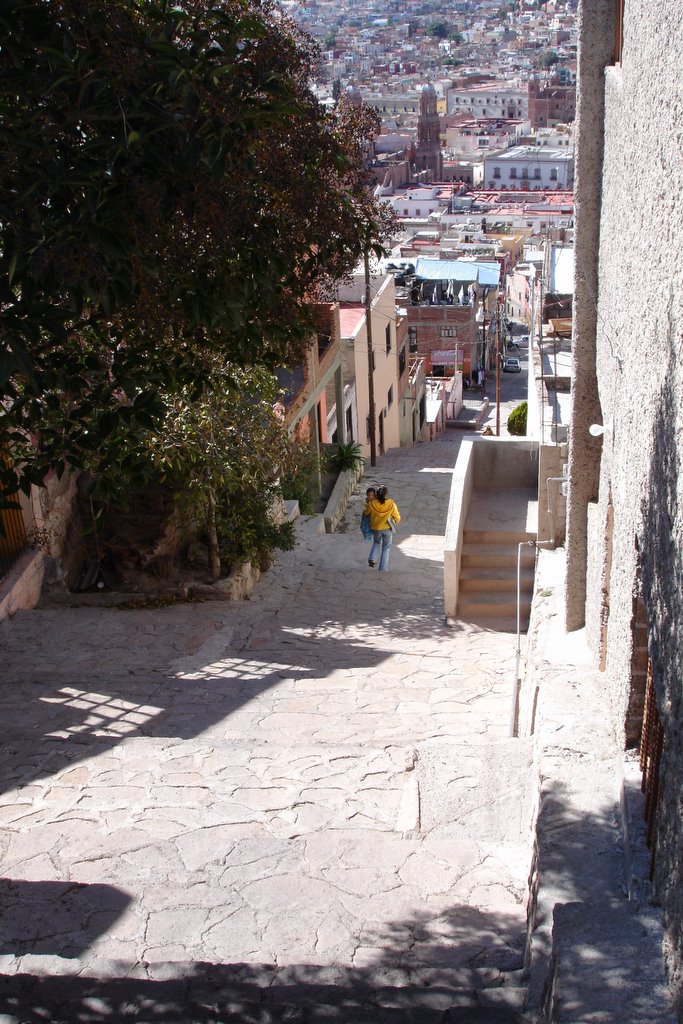
I was quite happy to be above ground again and decided to head up Cerro de la Bufa - a large hill overlooking the city. Normally you can get there by the Teleferico, a cable car that leaves from near one of the mine´s exits. However strong winds meant the service had been suspended so I had to walk. Although the centre of Zacatecas is pretty level, as soon as you stray far beyond the hills start to slope steeply upwards and the pavements turn into sharply angled staircases. Not a great combination with the Mexican diet of carbs and cerveza. But seeing crooked eighty year old pensioners and mothers laden with children making their way up and down the stairways was motivation enough to venture upwards at a brisk pace.

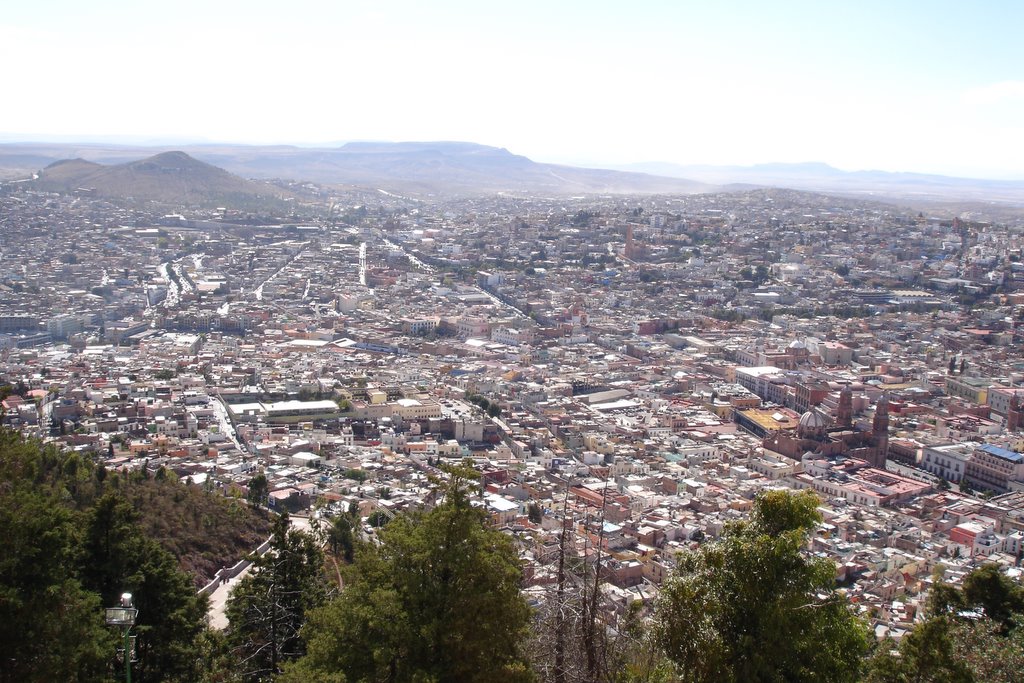
The view from above let me appreciate the city´s setting. Beyond the sprawling outskirts were the dry dusty hills of the northern desert. Well worth the effort getting there. After a quick pause to catch my breath I walked through an old chapel to find a carpark full of tourist buses for those too lazy/sensible to take the route I had.

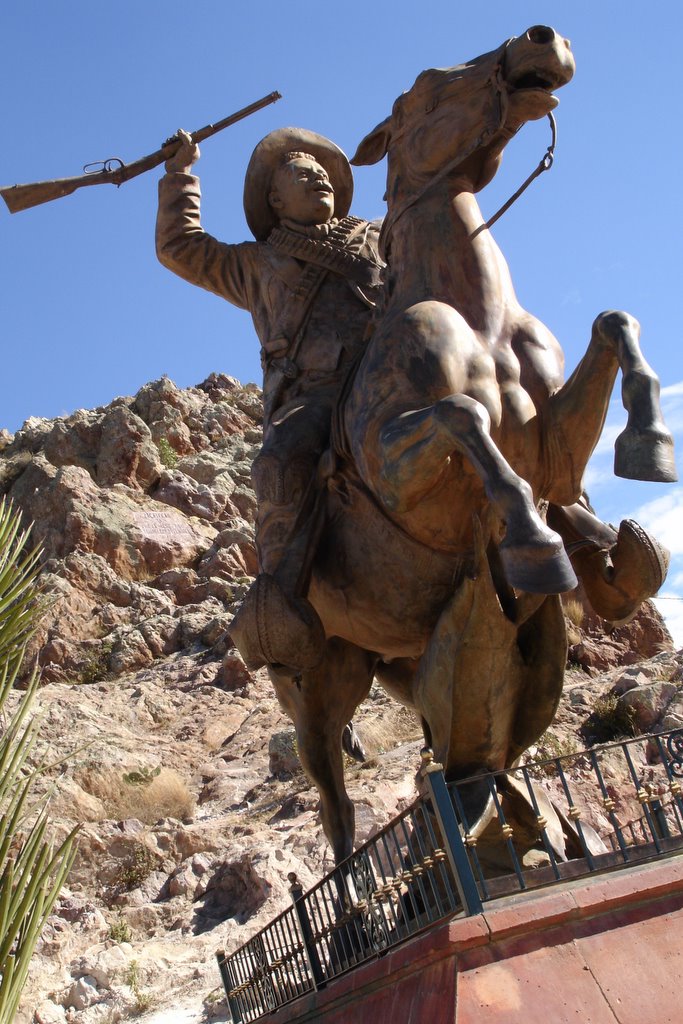
More impressive was a huge statue of Pancho Villa. While Europe was reacting with shock to the asassination of the Archduke Franz Ferdinand the Mexican bandit turned revolutionary general was making his name across the Atlantic. Having recruited a force of thousands of volunteers he took control of the Zacatecas in 1914, beating the official armed forces and forcing the resignation of President Victoriano Huerta. Near to the statue is the Museo de la Toma de Zacatecas which houses photos and newspaper reports of the battle as well as some of the weapons used.
There´s also a photo of Pancho Villa´s sister, Martina. Francisco ´Pancho´ Villa had led an unremarkable peasant´s life until a landowner tried to abduct his 12 year old Martina. Villa shot the man and fled to the hills where he became a thief. For more than 15 years he was part of several gangs, earning the cunning and leadership skills that made him such a charismatic leader of the revolution. And here ends the history lesson.

Having noted the other tourists wandering around the site I decided to leave the public paths and climb up the summit of the hill. In retrospect it was probably quite a daft thing to do alone - it was windy, the rocks were steep and it´s likely there were snakes in the undergrowth. But the satisfaction of being higher up than anyone else and looking down over the town more than made up for any risk. Nearly sprained my ankle after slipping on the way down though - if anyone else fancies the climb I´d advise proper walking shoes rather than the thin soled pair I was wearing.
In the hostel (the excellent Hostel Villa Colonial) that evening I bumped into a mad Italian and Austrian girl I´d met at Creel. Whilst chatting I discovered the latter had also studied at Solexico, but had left a few days before I arrived. However she knew most of the people I´d been friendly with - either a bizarre coincidence or more likely further proof that there aren´t actually tons of people travelling round the country at the moment.
That night I briefly joined a callejon - a group of musicians who´s music attracts large crowds of party people attracted by the tunes and cheap tequila on offer. Everyone would follow the musicians, like a modern day Pied Piper, from square to square causing absolute havoc as they blocked roads and caused major tailbacks of traffic.
But by 11pm I was back at the hostel as I´d booked a 5.30am bus to Guanajuato - my penutlimate destination - the next day...
Frontier Lands
Bleary eyed I arrived at Los Mochis station to get my ticket, five minutes before the ticket office was due to open.It appeared several others had camped out there overnight to ensure they´d get a seat. Half an hour later the ticket booth operator finally turned up - Mexico time!
As advised by the LP I asked for a window on the right hand side (ask for the left hand side if coming from Chihuahua) to guarantee the best views.
The first hour and a bit of the ride, up to El Fuerte, allowed views into the back of several people´s houses with wild pigs, chickens and other animals all running around their backyards as the sun slowly rose.

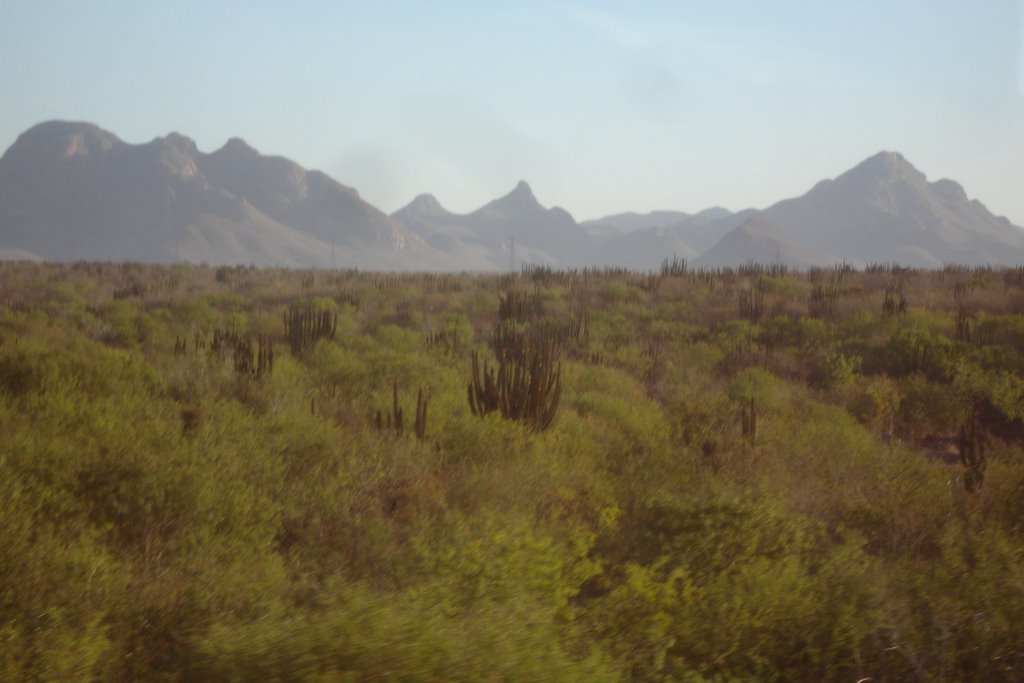
Then the first hint of the Barranca del Cobre (Copper Canyon) as mountains appeared on the horizon through a vista of catcus plants. The Ferrocaril Chihuahua al Pacifico boasts of being the world´s most scenic railway journey - and most of the other passengers sharing the first class train with me were late middle aged or retirees attracted by the promise as well as a scattering of local businessmen travelling north - most locals take the later second class train which runs slower and later. It´s half the price but it`s schedule means there`s the risk darkness will have fallen before you´ve experienced all the best views.
About an hour beyond El Furte the scenery began living up to expectations,

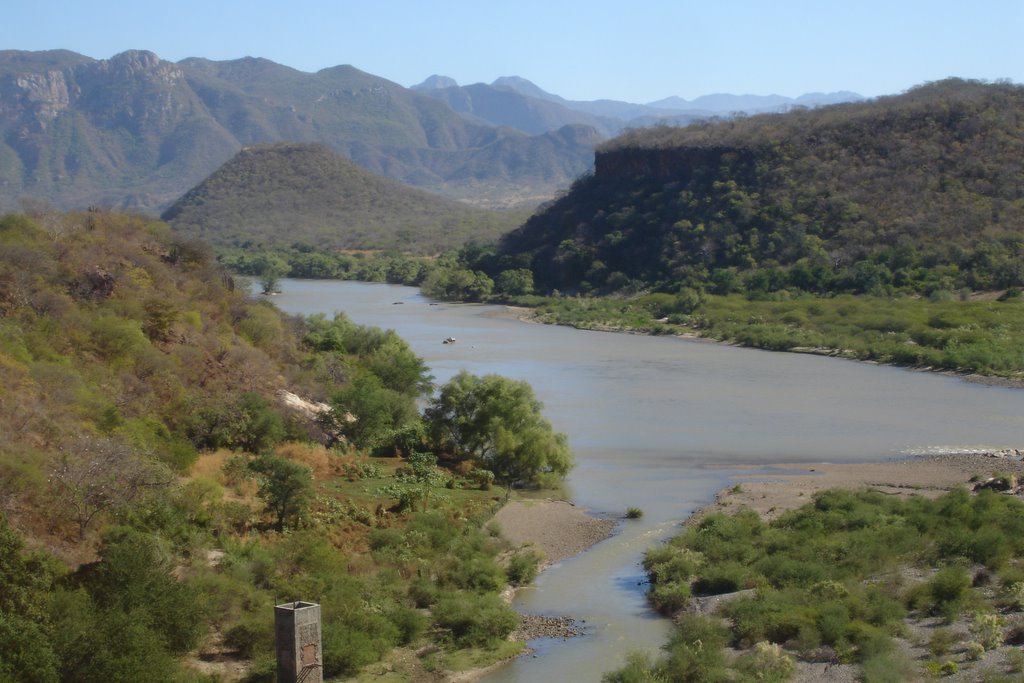
huge lakes, drops into deep valleys, waterfalls running down cliff-faces, river beds lined with boulders, then the train would thunder through a tunnel to reveal a new landscape beyond. Well maybe not thunder... the carriages are dragged along 655km of line by a self-powered engine, so perhaps chugged would be a better description.
The line opened in 1961 several decades after it had first been proposed and is one of the engineering marvels of the Latin American world. Freight trains also use the route but it`s tourists who help make the line ecomically viable - in peak season you need to book ahead to be certain of a seat - and it`s the same tourists´ pesos that have helped the several towns along the route grow in size over the past half a century.

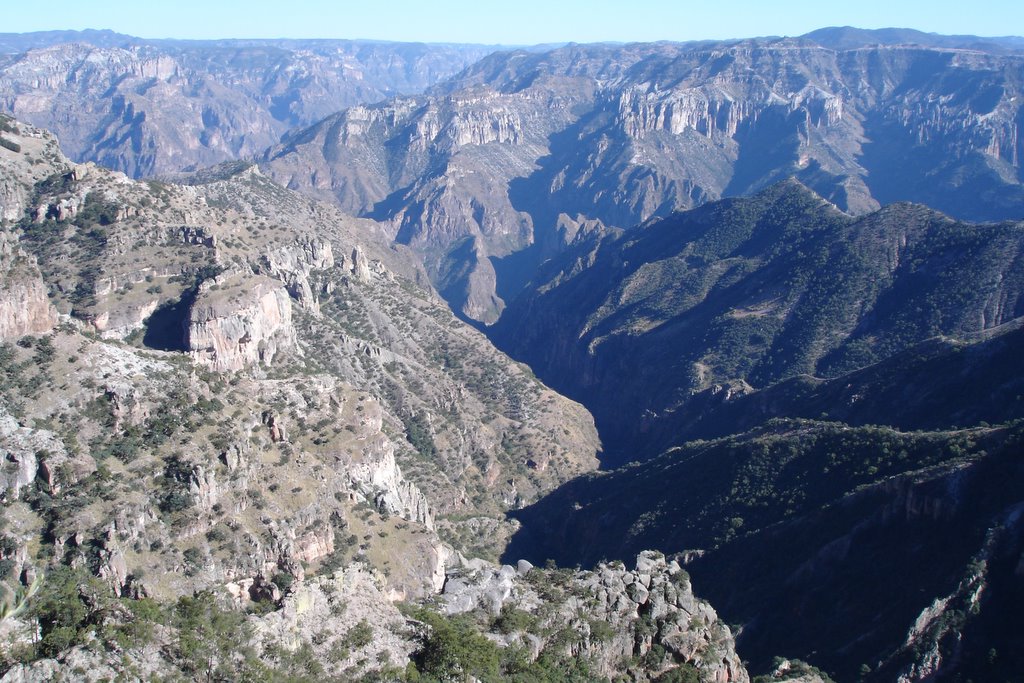
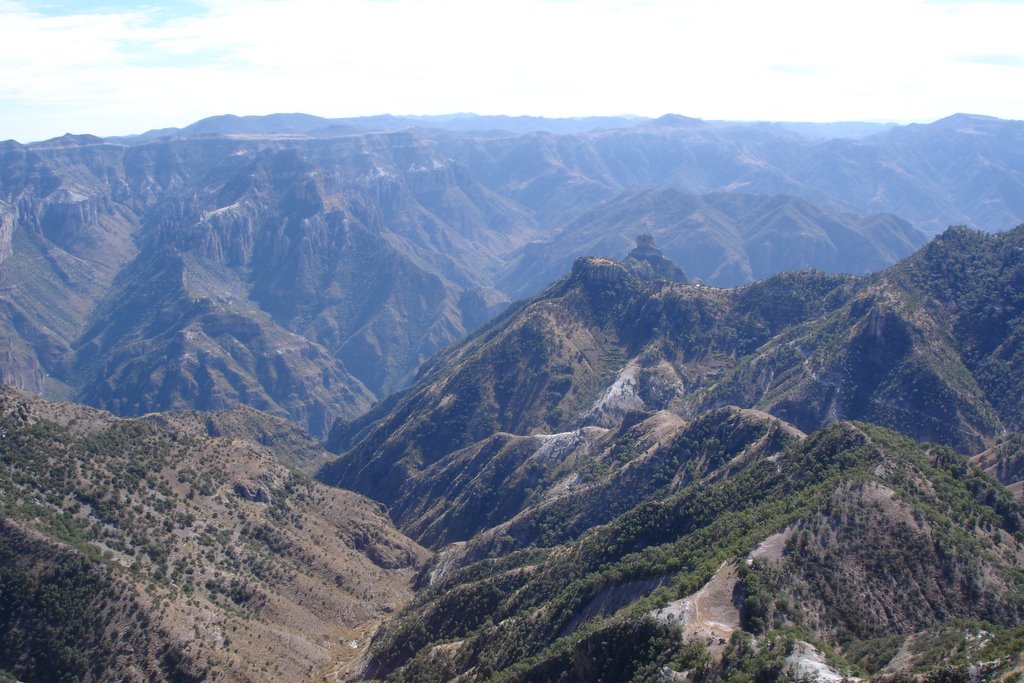
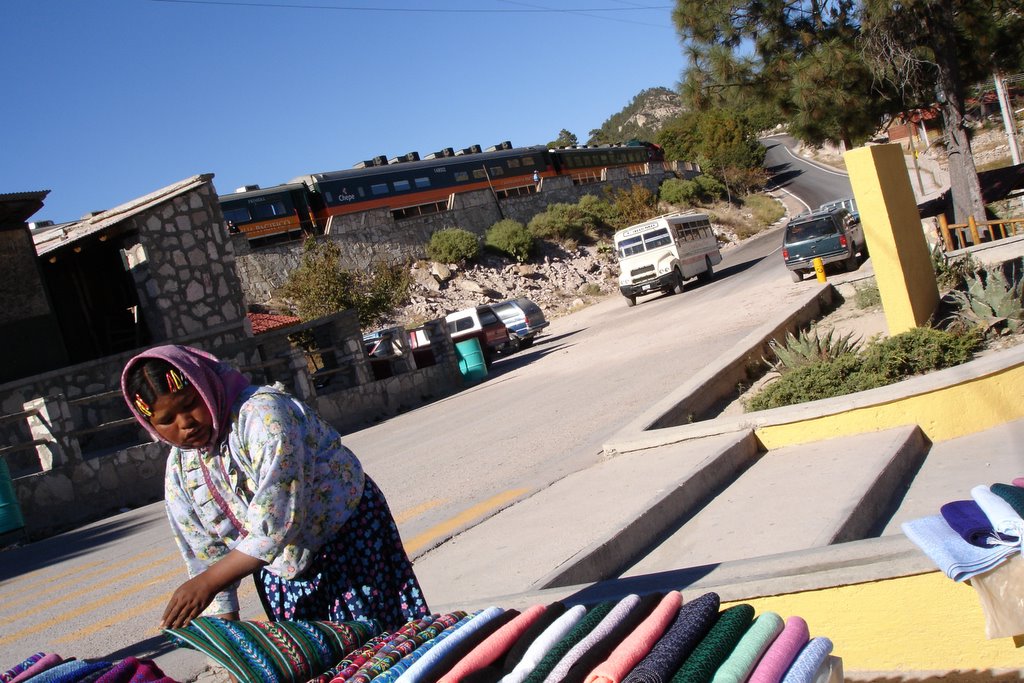
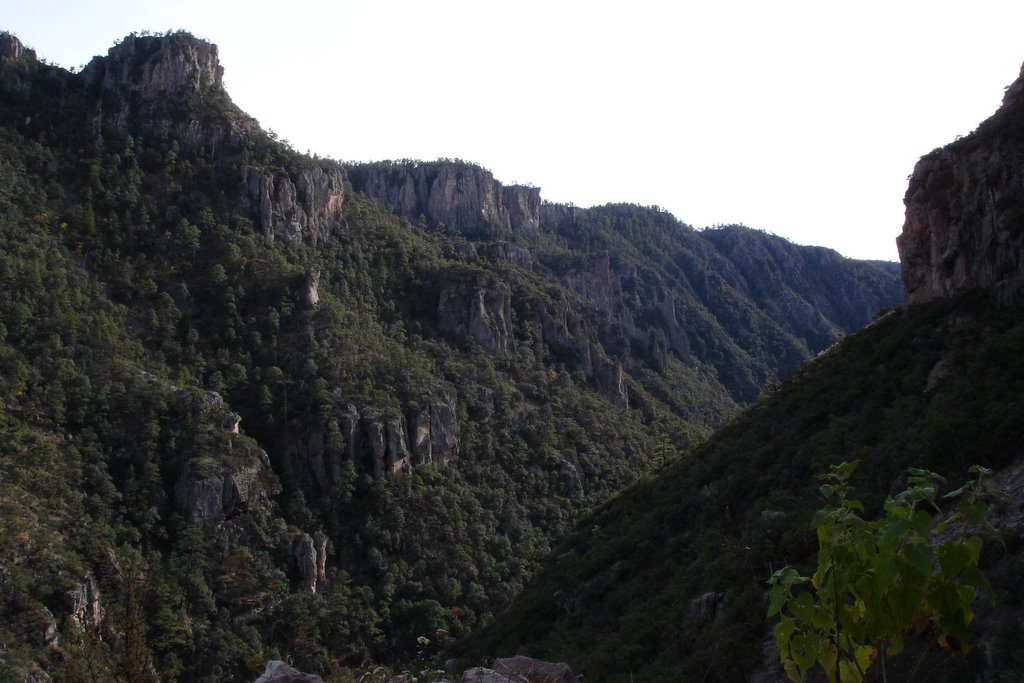
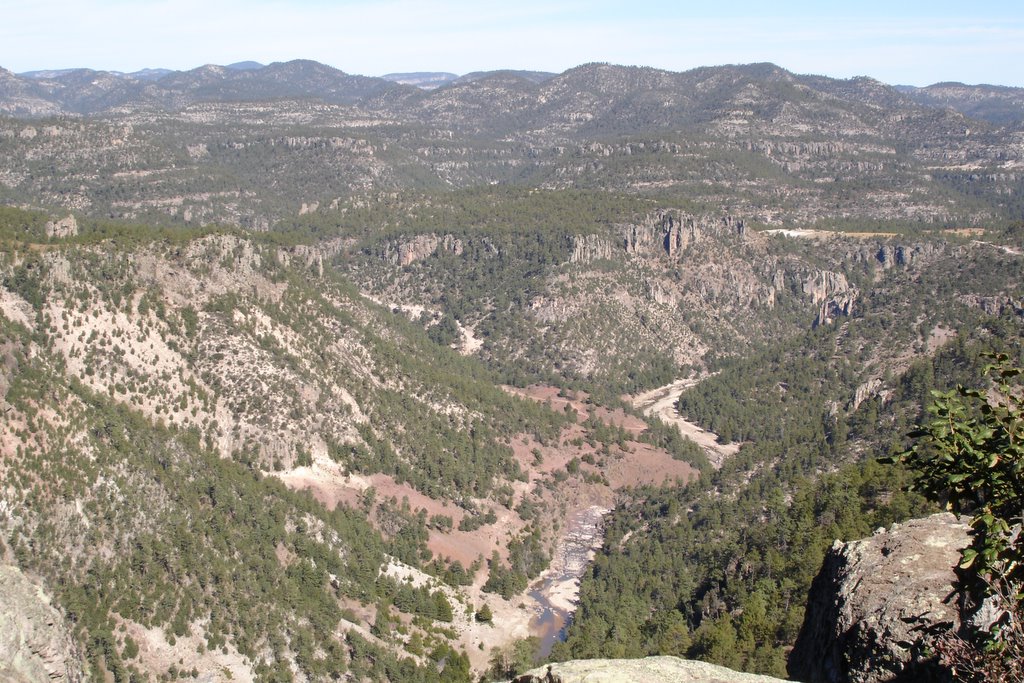
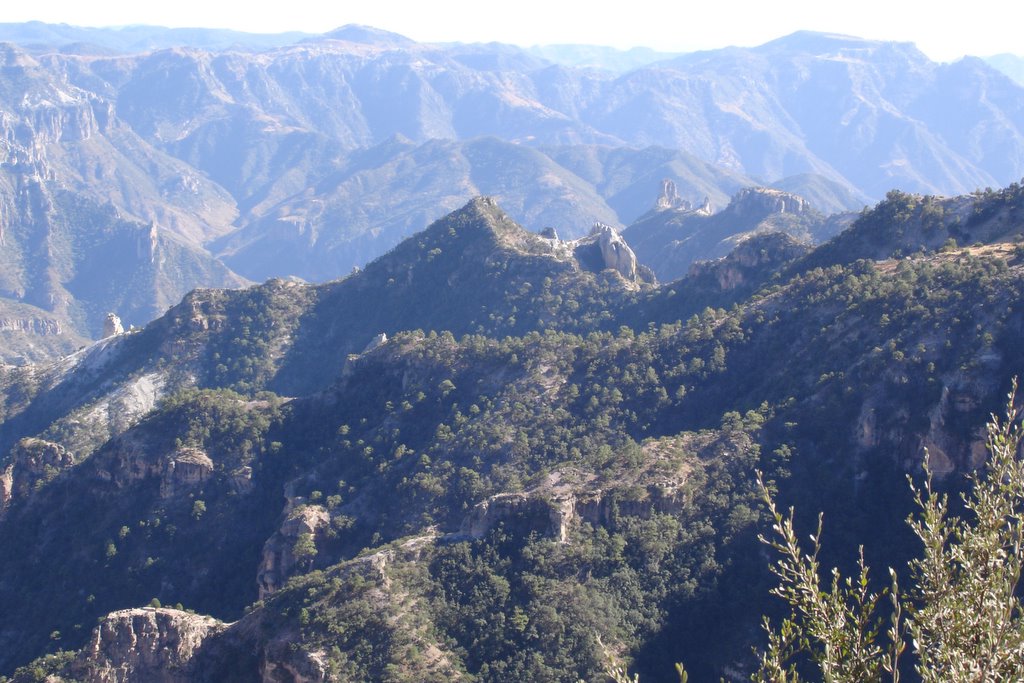
Although the views are inspiring, the best sight is at Divisidero where the train stops for 15 minutes to allow passengers to disembark and gape at the Barranca Del Cobre itself. 1879 metres deep with peaks 2300 metres above sea level it dwarfs the USA´s Grand Canyon. Copper plates and souvenirs are sold at street stalls by the sation, but the canyon doesn't derive its name from any seam of metal embedded in the rock, but rather from the colour it reflects in the late afternoon sun.

The eye doesn´t know where to look - skipping from peak to peak, from valley to tree lined cliff-face (the photo on the left and the one above only show only a small part of the view - you´d need to stick several pictures together to get an idea of the panorama´s width). The vegetation is all the more impressive as it grows right out of the rock - geologists believe it gives us a hint of what the American Canyon will look like several thousand years from now once it has caught up. As I´d later see the trees are widening several of the valleys - their roots slowly breaking up the rock which splinters sending boulders crashing down to the valley floor, while seeds fall into the newly produced cracks allowing the process to repeat itself.

The minutes shot by before the train`s whistle warned it was about to leave. It would be all to easy to get left behind, tempted by one more picture. The a further hour and a half journey to Creel. By this point we´d experienced most of the best views as pine tress obscure further sightlines into the canyon´s depths, although there are fleeting glimspes.

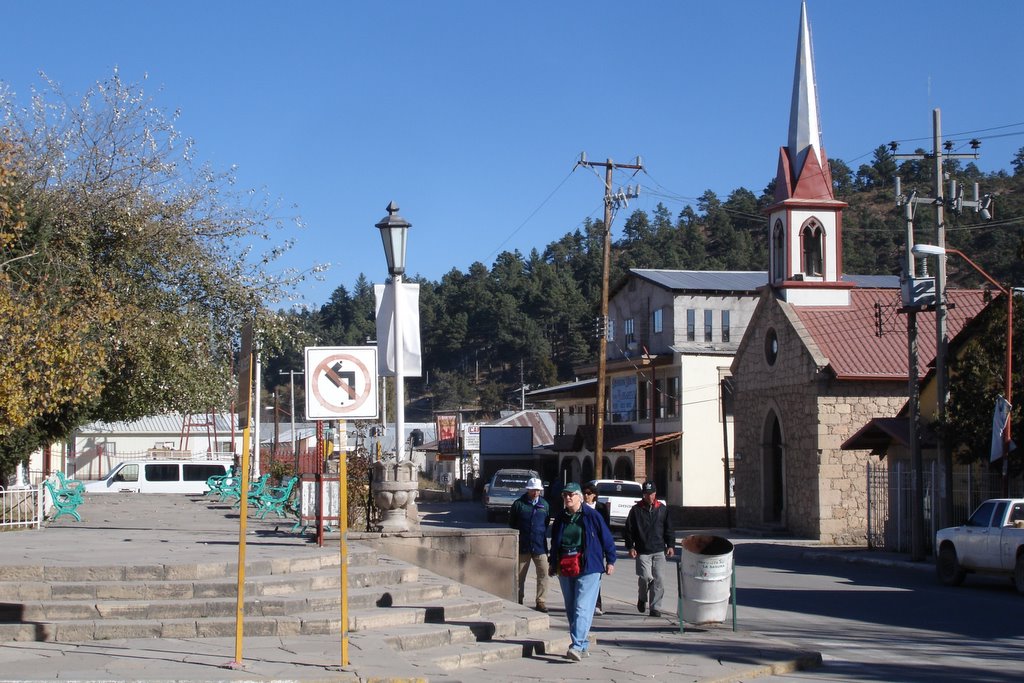
I got off at Creel station, just over half way along the route. It´s a small town with almost all the activity taking place on two roads running either side of the railway line. After hunking my ever heavier luggage onto the platform I was swarmed by a bunch of kids shouting out `Magarita´ - the name of the hostel I`d booked a place at, so I followed them and boarded an ancient bus. The driver must have been about 10 years old and offered me and the other passengers the choice of 2 places to stay - the ramshackle, but fun, Casa Magarita or the more upmarket Hotel Magarita´s Plaza Magarita. An American couple in their 50´s were bewildered by the kids´ Spanish chatter so I translated for them explaining the choice between the two. On discovering I was from Scotland the American woman complimented me for the quality of my English. Scary.
They decided to go for the more upmarket option while I stayed on board for the Casa - which turned out to be metres from where they`d first picked me up! All the same the chance to be hurtled around town by a driver not old enough to shave is worth the experience.

The hostel itself is a higgledy-piggledy assortment of building containing ´cosy´ but comfortable double-bedded rooms as well as a dorm. A private room is about 300 pesos which is a bargain as it includes breakfast and dinner. The food isn´t gourmet and included heinz spaghetti and green stuff on tacos for dinner and a suprisingly tasty white gloop with fruit as part of a huge hearty breakfast. But the huge bonus is that everyone eats together at the same time meaning it`s a fantasticly easy place to meet other travellers, and sign up together for one of the assortment of tours offered by the hostel. And - as we did on my first night - go drinking together.
I´d arrived in the quiet period, and although Casa Magarita was busy many of the other hotels were empty. A couple of girls I met the next day had resisted the boys shouts and checked in elsewhere only to find they were the only guests - and ended up coming round to Magarita´s in the evening to book tours and meet the rest of us. Another side effect of low season was that all the bars were closed the first evening with the exception of the Best Western Hotel´s which was hosting a party for a group from Mexico City. We gatecrashed the event, were offered shots of tequila and sipped some of the country´s most expensive beers as the Mexicans sang folk songs and increasingly slurred voices.

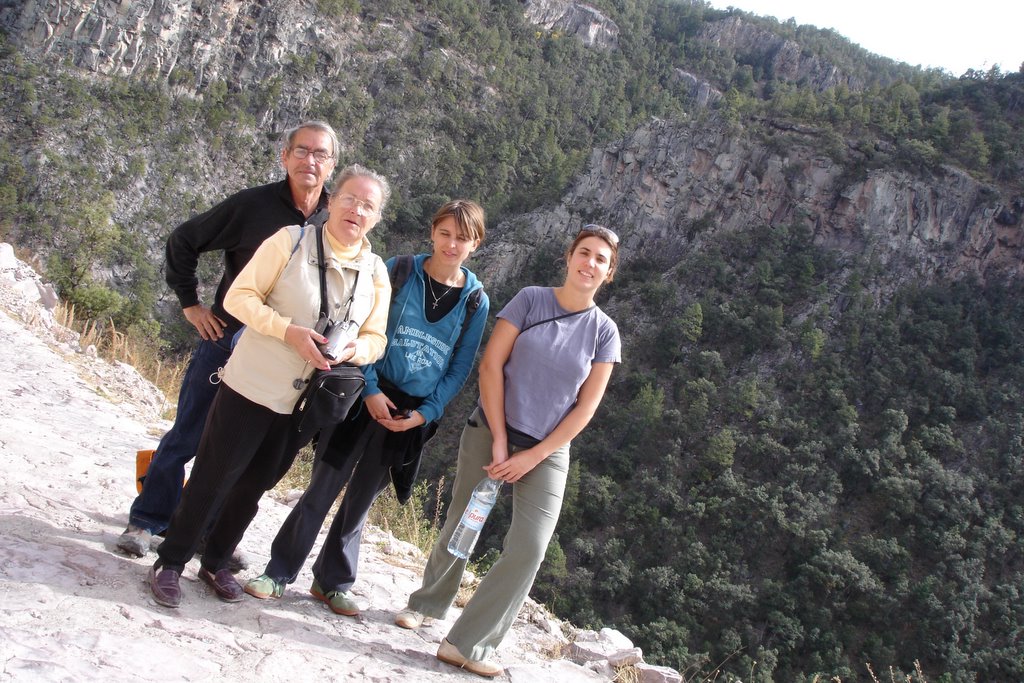
I´d signed up for a visit to the Hot Springs the following morning. My fellow travellers were a retired couple from France, and two French girls in their late 20´s who I mentiuoned in the previous paragraph. Communication with the elder pair was a mixture of my terrible schoolboy French and their only slightly more impressive English.
Despite this we managed several basic conversations in between his copious photo taking. I swear he must have a photo of just about every

possible bit of scenery from the day. He filled a 1GB memory card, swapped it for another and continued snapping away. They had come over to Mexico after their son married a Mexican girl and were now enjoying a 2 month trip of a lifetime - and obviously not wanting to forget a single sight.

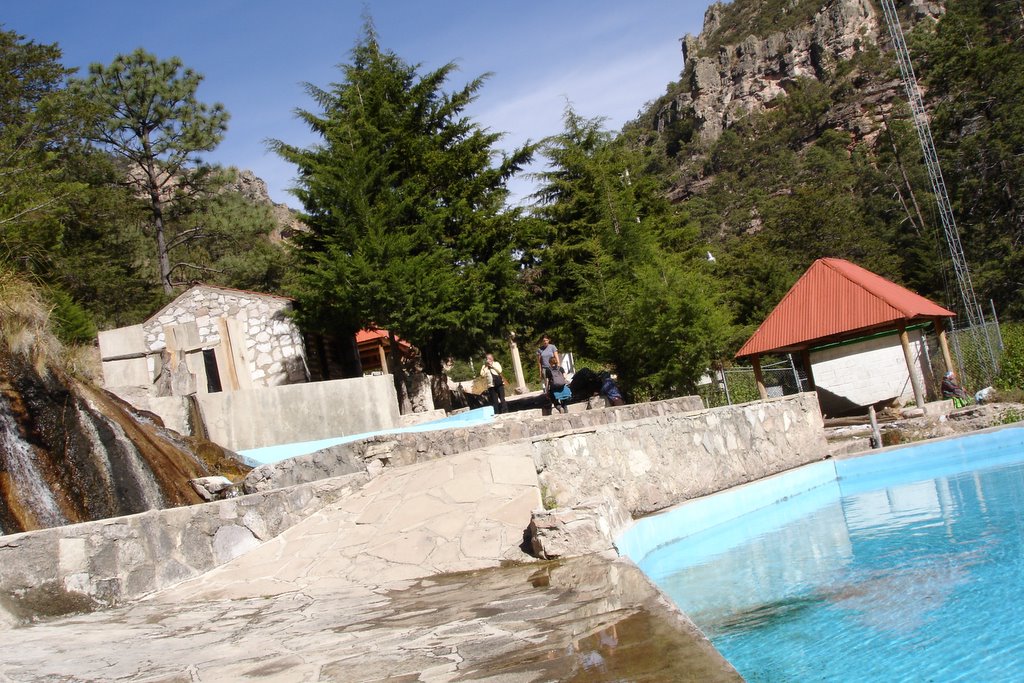
To get to the springs we were driven about 45mins out of town into the forest and partway down a thin rough path. Then the `tour-guide´ announced it was time for us to hike the rest of the journey while he took a 4 hour nap. The walk down to the valley floor allowed some spectacular views of the cliff faces above and the temperature began to noticeably rise as we made the steep descent.

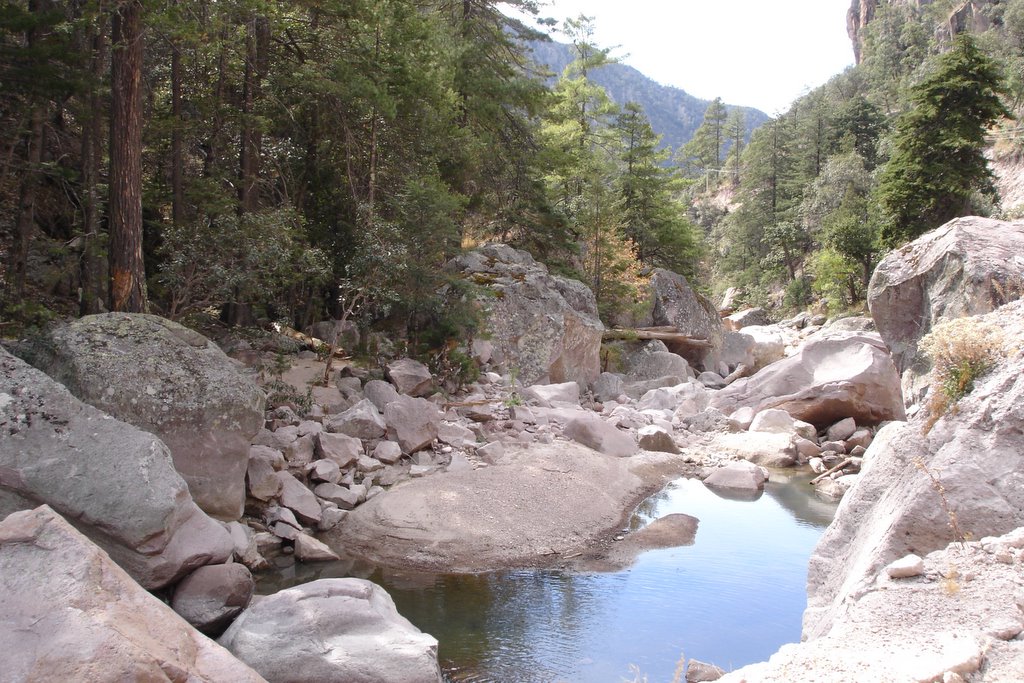
Then we followed the a slow moving river round several more bends until we finally got our first glimpse of the springs themselves. I was expecting a natural pool, like the ones I´d visited in Chiapas, but in fact the waters were collected in man made basins just above the valley floor. The warm water originates higher up the rockface and runs down the rocks into the first of a series of interconnected pools, each bigger than the other.

This meant a dip in the smaller pools allowed us to experience the warm water as it crashed off the rocks onto our backs providing a massage as if from a supercharged shower, while the bigger pools, which were large enough to swim in, offered the contrast of a more chilly invigorating experience.
We stayed at the bottom a couple of hours, sunbathing, swimming and generally chilling out before a strenous hike back up to our dozing driver.

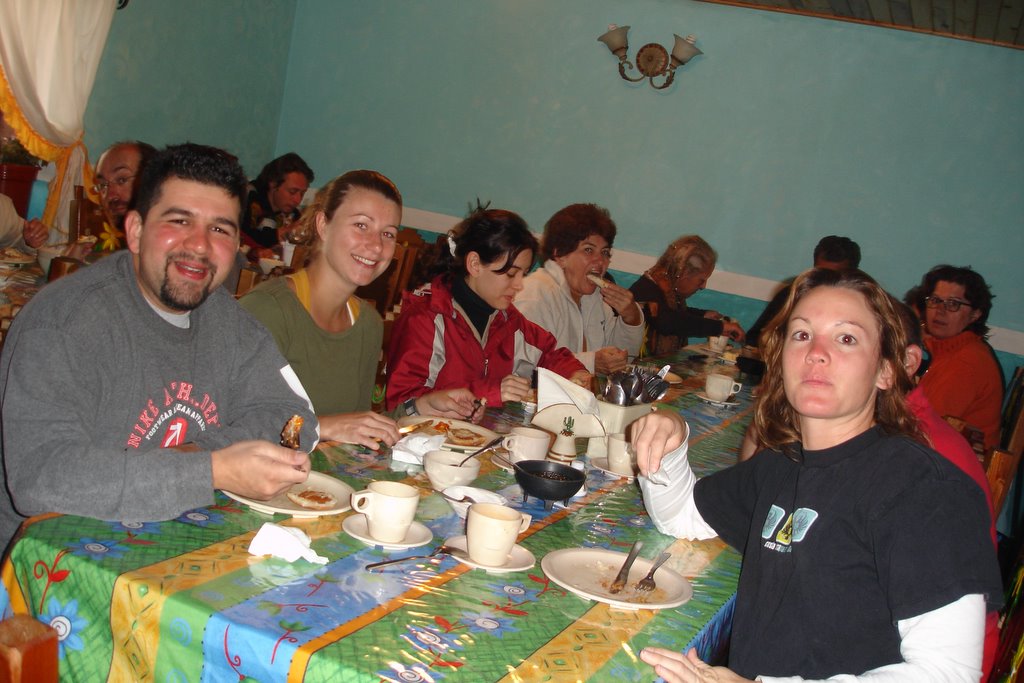
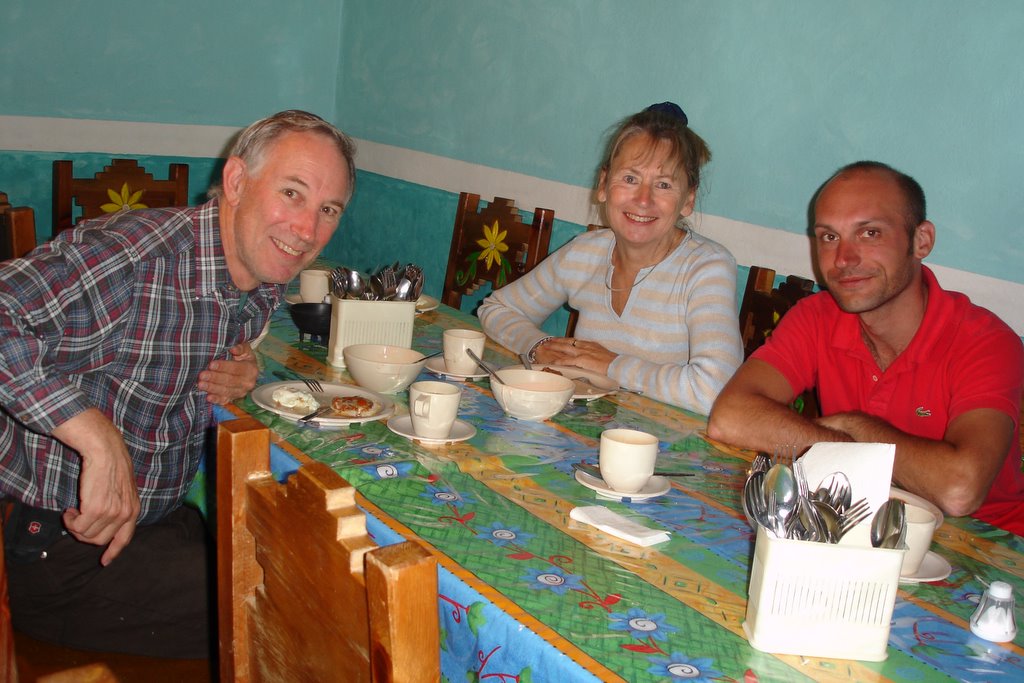
At the hostel I met a Dutch artist I´d chatted to the night before and we went to the now open Tio Molcas bar to begin a notable drinking Tequila and cerveza session which was only temporarily interrupted by dinner back at the hostel. We were joined at times by a very cool married couple from Canada (also seen in the above pic) who had driven an RV down to Mexico, a younger American pair of teachers from the US, a 20-something Belgian translator who´d left her job to travel Latin America alone, the French girls and the Mexican barkeeper.

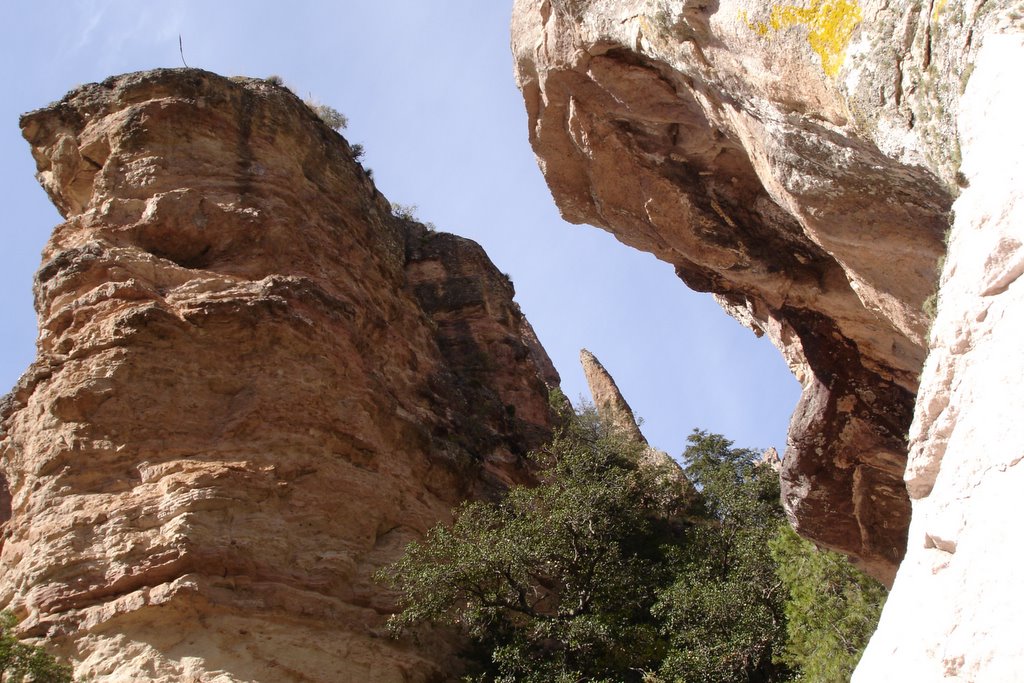
I decided that I´d travel onto Chihuahua by bus the following day instead of by train as it would give me more time in Creel and the chance to go on a second tour - this time to visit several of the surrounding Canyons. Although the area is known as the Copper Canyon there are in fact more than 20. As we enjoyed the vertigo inducing views our guide informed us that much of the surrounding area is inhabited by the Tarahumara tribe - many of whom have never travelled to the towns or villages and live in log cabins or in some case caves. Like many of Mexico´s other indigenous tribes, the 50,000 Tarahumarans wear incredibly bright clothes which presumably make them easier to see at night far from the nearest electrical lamp ;)
The tribe is perhaps most famous for its long distance runners. They developed the skill to help them hunt deer, exhausting them with long chases before driving them over cliffs. In 1993 they came to the attention of an American entrepeneur who entered them into the Colorado 100 mile ultramarathon. Victoriano Churra, one of the tribesmen, easily won the competition running the distance without rest with little preparation. He´s gone on to win several other American competitions.

The tour also took in a winding road across a cleared area - it had been a landing strip for tourist planes but was abandoned after the authorities discovered drug smugglers were also making use of it at night. Then finally we were driven to the main Copper Canyon again where we saw very shaky looking ladders the Tarahumara use to scale up and down the rockface - it takes them 2hrs to get from the top to the bottom - there was no way I was even going to hang over the edge to reach he first rung.

Ted, the Canadian husband ventured out onto the `floating rock´ to balance precariously above the huge drop to the disbelief of his wife before they bought several baskets the Tarahumara intricately weave out of grass and sell for a couple of pesos. The wife crammed so many in her bag that they´ll probably be flattened into table coasters by the time she gets home.
Then time to say goodbye to another group of friends and board the bus for a 22 hour bus journey to Zacatecas via Chihuahua...
The Thin Line
Last day in San Cristobal and time to move on.
Lasting memories that didn´t make the previous entry include a cd shop where the owner offered to burn copies of the discs if I thought the price of originals was too much, pavements with sidewalks several feet above the

road (during the wet season the rainwater runs so deep that several streets effectively turn into rivers), a wonderful exhibition by a local artist whose pictures spilt over the canvas and onto the frames, finally finding a decent cup of coffee in `el museo de cafe` run bv a co-operative of local farmers (there´s going to be a diatribe about the difficulty of finding a decent cup in a later entry), drinking cheap wine in the hostel before going out and a seemingly endless choice of shops offering the same swiss army knives - I cracked and got a small black one - still looking for a use for it a fortnight later.
The next stop was Los Mochis - the gateway to the Copper Canyon. I needed to catch a couple of flights to get there which meant taking a taxi from the hostel to Tuxtla Gutierrez airport. The journey was about 90 minutes and the driver chatted away the whole time - I reckon I understood about 80% of what he was saying. Most of it was complaints about exploitation of the area by big business and the hugepiles of rubbish other drivers had chucked out of their windows and which now lies scattered in piles along otherwise jaw-droppingly scenic routes.
It was Revolution Day so the start of the journey was fairly slow as several groups of school children were marching up and down streets, playing music and celebrating the anniversary. But once out of town the driver had his foot to the gas and we shot along at a blistering and frankly shit-scary pace. Near the end of the pay road we both saw the wreck of a blue car on the right hand side which was being loaded onto a pick-up truck. Both ends had been rammed. On exiting the road the taxi driver asked the pay toll operator what had happened - a crash less than an hour before. The dmotorist was killed instantly. My driver crossed himself - ´hay una linea fina entre la vida y la muerte´ he said.

I had to fly via Mexico City, first with Click Mexicana - Mexico´s first budget airlin - and then with Aeromexico. In fact the former offered a higher level of service than it`s more expensive competitor including free drink and a highly efficient service. Unlike it´s European equivalents it also organised my luggage to be transfered onto the second airline making the whole experience stress free.
I arrived in Los Mochis at about 8pm allowing for an hour´s time difference. I´d booked into Hotel Fenix (001 668 812 26 23) as the Lonely Planet warns travellers off the town´s only budget option. Despite being the most expensive night´s rest so far it wasn´t hugely impressive. Generator noise leaked into my room, the hot water ran out quickly, 55 TV channels but nothing worth watching (though I guess this wasn`t really the hotel`s fault) and a requested alarm call never rang - the reception clerk said he did call, I guess someone else got it. I´d asked for the call as the train left the next morning in the very early hours and I needed to be at the ticket office by 5am to guarantee a good seat. My alarm clock had picked this moment to go on the blitz - typical.
From the little I saw there´s really no reason to stay at Los Mochis except as a stopover before entering the Canyon - though if you do I´d recommend the flautas de cameron (small crispy toasted tortillas filled with tiny cubes of prawn) at El Farallon (corner of caller Flores and calle Obregon).
Zapatista Land - Waterfalls, Ancient Cities & UFOs
After calm days of not doing very much on the coast the past five days have been quite a contrast. I arrived in San Cristobal de las Casas after a 13hr overnight bus ride from Puerto Escondido.

From sea level to above the clouds - the last few hours of the ride offered dramatic views of the valleys as we rose higher and higher up from Tuxtla Guttierez into the mountains high up into the skies. They were considerably more atmospheric than the terrible Steven Seagal film the bus company inflicted on us for the first couple of hours of the ride. I swear the Mexican bus companies source out the worst possible DTV drivel they can to inflict on the gringos who ride primera clase - and unless you have earplugs of a walkman there´s no escape as the sound is blasted around the bus. It´s a suprise more drivers don´t deliberately drive over the cliffs in desperation.

Anyway back to SCdlC - the town is reminiscent of Oaxaca - lots of narrow streets arranged into a rough grid like pattern. But here the streets are narrower and are thronged in places by the inhibitants of nearby indigenous villages who come here in search of work. They have darker features and brighter clothes than the Mexican-Spanish Mexicans and often fierce expressions of concentration on their faces.
The town hit the headlines on New Year´s day 1994 when a left wing guerilla army, the Zapatistas, stormed the city - their aim to overthrow the establishment and improve the living standards of the native `Indian´ tribes - some of whom had never been conquered by the Spanish conquistadors but had fled to the jungles of the area to face problems decades later from loggers and farmers who deforested the land making it more vulnerable to flooding and hurricanes. The army eventually forced them back with around 150 casualties (mostly Zapatista) but the groups leader Subcomondante Marcos is now a cult figure. The ex-university professor´s masked pipe smoking face is featured on several t-shirts sold and worn around the town. Negotiations with President Fox have taken place but agreements have never been put into place. Though the group is now mainly non-violent, and spends a lot of its efforts fighting a public relations battle over the internet, there are still tensions. Driving down some roads in the area you encounter signs declaring the surrounding areas Zapatista territory.
There´s more information at:
EZLN Global Exchange
The zone, like much of Mexico, is also Volkswagen territory thanks to the German company locating several of its factories in the country. Speaking to Mexicans it´s amusing to learn that Volkswagens here have a reputation for being unreliable cheap cars unlike their European counterparts. I spotted the example seen on the right just after arriving - many examples are in far worse condition.

I spent the first day here wandering the streets trying to get a feel for the place. One of the joys of being a single traveller in this part of the world is that locals often come up to me, ask where I´m from and start a conversation. It´s interesting that they often assume I can speak Spanish. Reference to Braveheart (or Corazon Valiente) helps to explain where Scotland is, although not every time. One girl asked a fellow traveller where she was from - when she replied Europe the girl asked where in the USA that was. In my experience though every adult has at least heard of England and London if not Scotland and seems amused by my descritions of our weather.
As atmospheric as the town is the reason it´s become such a travellers haven is that it is the perfect starting point for tours into the Chiapas region. For my second day here I went on the daddy-of-them-all. A 14hr trip to Palenque via two waterfalls.

The ride itself is an experience. 11 other travellers from Argentina, New Zealand, South Africa, Mexico and England and myself were packed into a white van at 6.30am which then sped around narrow mountain roads at high speeds. There´s no crash barriers and the drops go on for over 1000 metres in some spots so you´re really putting your trust in the driver and hoping the fact he must have driven the same route thounsands of times will help. (Actually yesterday´s newspaper headlined with a collectivo crash caused by high speeds - two women are described as `flying´through the air!). Anyway after a brief breakfast the first proper stop was Aguas Azul - a series of wide waterfalls in the middle of the jungle.

I´d met a group of girls (Sinead, Gaby and Zoe who had worked together in a Walkabout Pub in England) on the bus and we set off together to walk along the falls before the fun part - diving into the waters. The first 30 seconds are bloody freezing but then it seems the temperature rises - or maybe it´s just the body going into shock. Anyway it was a pretty amazing experience - only enlivened by helping a French pensioner swing over the water holding onto a monkey rope.

Another hour and a bit later we arrived at Misol-Ha. If you click and enlarge the photo you can get an idea of its size by looking at the people walking behind it in the hollowed out area. Once again we were able to dive into the waters and this time swim under the falling water. The force of the water meant that as soon as we stopped swimming we were pushed back again towards the edges of the pool.

Then finally, at around 4pm, we arrived at Palenque itself. The size of the site is mind boggling. The ruins of pyramids, tombs, observatories, palaces and pelota courts stretch over 16 square kilometres - mostly still covered by jungle and screaming howler monkeys - one of whom produced an very impressive stream of urine from a nearby branch during out tour. We ended up touring with a Spanish guide which meant I had to provide an English translation for the girls. I think I got most of it right, though there may have been a couple of unique facts that could have crept in.

Since we only had 2hrs to tour our guide concentrated on the main excavated area. The Mayan city was first occupied around 100BC and reached it´s highpoint around 700 years later. But by 900AD it had mostly been abandoned - it´s thought because the land was exhausted and the inhabitants could no longer sustain themselves. It´s been claimed several tribes descend from the Palenque people but no-one knows for sure where they scattered to. There´s lots more information at:
Palenque Mesoweb
One story that made me check my translation was about the carving found on the tomb of the city´s most famous king, Pakal (seen on the right). Erich Von Daniken claimed it showed the king riding a spaceship giving credence to his `ancient astronauts´ and `Chariots of the Gods´ theories. Archaelogists argue he´s bonkers - and looking at the picture the wrong way up. In fact it shows the king at the point of death, laid out in the fetal position (as was the Mayan custom) in between the heavens, earth and the lower world. If you prefer the former version there´s more madness at:
Palenque MesowebUPDATED: Palenque was first revealed to westerners in the mid 18th century when Mayan hunters revealed it to a Spanish priest, but it was almost two hundred years later that archaelogists cleared the vegetation from the dead king´s huge crypt. Many buildings are still obscured and several ´hills´ in fact contain further unexplored features. However clearing away all the trees and plants could cause some of these structures to collapse if costly supporting scaffolding were not first put in place. For the time being Palenque´s half discovered nature will add to it´s mystery and appeal.
OK that was 1st day´s tour! After a five hour drive back to the hostel I was exhausted (lots of sitting around in the back of a bus does that - very tiring!) and since I already had another tour booked for the next day had an early evening.

Thursday´s booking involved a trip to the Lagos of Montebello, the Grutas de San Cristobal and another huge waterfall who´s name I can't remember or locate in the Lonely Planet). Another coincidence - on the tour group of 5 people was another student from Solexico - Annalie, from Sweden.

She´d finished studies a couple of days before I started but we´d briefly met at one of the school´s weekly ´go out and drink a lot of alcohol sessions´. In the traveller´s world that equates to a long established friendship and proved once again going on a tour is a short cut to making friends in an unfamiliar city. It also meant it was worth packing my cd headphone splitter as we could share some tunes on the long drives between destinations.

First stop was the caves - or more accurately one long huge passageway deep into the earth. According to the LP the army took control of the area in 2003 but there was no sign of them when we arrived. Instead there was a local native girl offering a tour of the cave which consisted of pointing a torch at the walls and claiming the rocks looked like 'cosas que faltan algo' - things that lack things. So we were treated to rocks that looked like faces lacking a nose, bodies lacking arms etc Quite amusing but kind of scary after about 15mins. I think you really have to be quite high on peote to see half of the things she claimed were there.
Next stop was the day´s highlight - a 30min trek into the forest to a HUGE waterfall - standing on a platform metres away we were both soaked. Then slightly downstream we went for a dip in the freezing crystal blue waters. I´m not actually sure you´re allowed into the section we went to - the water was very fast moving and in parts if we hadn´t grabed onto a submerged tree roots we would probably been swept down the rapids. Nothing like the promise of a brutal death to get the adrenaline going.
The guide gave us a curious glance when we got back to the van - he was worried we{d soak the seats (sitting on towels saved that problem) - and we shot off to the lakes only making time for a short delay when the police pulled us over for being severely over the speed limit. The lakes were pretty, but with only 20mins on average to look at each one there wasn´t much to do except grab a few pics and allow lake fatigue to set in.

And onto the third excursion - the Canon of Sumidero. This is VERY impressive and well worth booking an extra day in SCdlC to visit. After arriving at the edge of the canon our tour group was piled into a fast moving boat and we shot at very high speeds across the water - we seemed to have a supercharged boat that outpaced all the competition on the water and sent a bracing breeze across our faces. No worries as there is lots to marvel at. The photo showing the three walls is found near the start and is the symbol of the state of Chiapas found on government posters and other material across the area. Along the way we saw lazing crocodiles, herons and other waterbirds, a waterfall that flowed behind the cliff-face to emerge halfway down giving life to a startling array of plants which grow right out of the rockface - and then there´s the cliffs. At one point they stretch up more than a kilometre while and down below the boat for a further 350 metres. As eagles circle high overhead it´s easy to get the sensation of being a very small part of a very big place. Then finally about an hour´s ride down the canon you come to a huge set of overhead electricity cables.
The canon was dammed several years ago to produce what is currently the world´s most powerful hydroelectric dam providing electricity to about 30 Mexican states (need to check that figure) as well as much of Central America. If you cut the wires a lot of the country goes dark.

Along the waters leading up to the dam boat loads of workers slowly empty the waters of dead vegitation and other rubbish that collects into huge slurries of rotting mass. We were told it´s slow and expensive work, but there´s no alternative. As each boatload of tourists pass (and there´s lots of them) the workers stop, look up, grin and wave at the gringos and fellow Mexican tourists.

For my last whole day in town I decided to keep it local but did pay a visit to the Na Bolom museum/project on the recommendation of a friend. The centre was set up in the ´50s to help protect indigenous tribes against those wanting to come in, take their land and use it for logging or agriculture.
Gertrude was a Swiss woman who had been involved in Socialist politics in her youth, was imprisoned in a German concentration camp and after the war came to live in Mexico. There she met the Danish anthropologist Frances Blom - they married and set up the volunteer project that has outlived them both. Gertrude´s life was fascinating - usually the Indians refuse to let anyone photo them, but they allowed her to take pictures of many of their most private ceremonies and her archive is now a unique resource tracking how the tribes changed over the 20th century. During this time she became very friendly with the last king of one of the tribes - he continued to father children beyond his 100th birthday, but since the Indians believe the world will end in 2012 they haven´t bothered replacing him. She was also friends with Frida Kahlo and Diego Riviera and was awarded one of the UN´s most prestigious awards before her death. A really fascinating insight into her life and the work she did - the guide said the new volunteers are lucky she´s dead as she would frequently have them in tears - she was obviously quite a complicated character. There´s a very good doco to be made about her life.... Anyone planning to visit SCdlC should try to get a place on one of the tours and there´s also the opportunity to stay for dinner and meet those working with the Indians. More details at:
Na Bolom Home Page
Just a couple more things - the nightlife is great - especially El Revolucionario (The Lonely Planet lists it under its old name) where there´s live music, projected films and free flowing alchohol every night - Blue nightclub is fun and if you fancy a change from all the Mexican food Maymbe on calle Real de Guadalupe is superb.
I stayed at Posada Mexico which you can book via hostelworld. I´d highly recommend it, and not just because they upgraded me to a huge room with ensuite bathroom at no extra cost. They provide a tasty choice of breakfast, free internet, will book tours and fall over themselves to help in any other way possible including running off to get a taxi at bargain rates.

It´s also a great place to meet other travellers - as can be seen: 2 more friends from Solexico (the alumni really do get about) and a couple of very cool Argentinians who have given me another huge list of music I HAVE to have! OK - doubt any more entries are going to be anywhere near this long....
Life's A Beach
One of the pleasures of travelling is the chance to experience unusual foods, and there's been plenty of opportunity in Mexico.

So far highlights have included mole negro (chicken in a savoury chocolate sauce) wrapped in maize leaves, cream of squash soup, several quesidillas, crunchy thick freshly cooked tortilla chips served with HOT salsa lime and salt, a cocktail of freshly caught octopus, pan de los muertos (bread of the dead), a chilli and pineapple paleta (pictured - basically an ice lolly made of pineapple chunks in a frozen chilli sauce - not nearly as nice as the strawberry version which includes whole strawberries in frozen strawberry cream - yum, yum, yum) and grasshoppers (which strongly taste like grass at the end of summer - which isn't surprising when you think about it). The grasshoppers were crunchy and to be honest after 3 or 4 I'd had enough - but they´re popular in oaxaca - fried in chilli and eaten on their own or wrapped in a tortilla with lime juice. You can even choose which size you want - small and crunchy or big and juicy.

Obviously with all the food alcohol is a necessity - after a few encounters with mezcal (fierce) I'm sticking to tequila, cerveza, capariñas and huge glasses of margarita on the beach (more of which shortly).
Anyway my time in Oaxaca has finally come to an end. After many many nights out with schoolmates in La Divina (a bar next to the Santo Domingo cathedral with great staff, a cool atmosphere and an impressive collection of girls' bras hanging over the bar) I had to prepare to leave.

The last day was a classic and probably the best I had in the city. We managed to sidetrack the teacher from giving us a planned translation exercise during the first class and then she agreed to take us to a bar for the second. There we decided to put our spanish to use by asking each other increasingly intimate questions about our personal lives. It's strange but speaking in a foreign language can be dangerously effective at breaking down inhibitions. Or maybe it was just having a bottle of corona at 11am.
Then went for a great lunch at a place recommended by another of the teachers (Cocina Magica - c/Macedonio Alcalá 203) which included a shrimp salad made with bits of Mexican fruit I´d never tasted before (hmmm - think I´m going to have to start watching the calories). Next played backgammon against Felipe in the zocalo, went to hear a trova (singer songwriter) concert at the city´s book festival, then headed

back to the house one final time where I packed my newly laundered clothes (clean pants - yay!) and said goodbye to several of my housemates (two of whom were also journalists). Bizarrely the Australian couple (Matt and Lucy - on the right) only moved in after I´d replied to a message they´d posted on Lonely Planet, saw my blog and then introduced themselves one morning at the school which they joined on my recommendation. Damn - should be on commission.

The trip from Oaxaca to Puerto Escondido was 14hrs on a first class bus with a snoring 40yr old sitting on my left and a screaming baby in the seat in front. Neither prevented me drifting off to sleep after a couple of hours - unfortunately every time the coach banked to the right my head bounced off the window frame - so whatever sleep I got was pretty fitful. By the time first light came up I had no desire to sleep anyway - the view from the window was too good - miles upon miles of forest/jungle with a rich abundance of trees and birds interspersed with small villages where the beer adverts often looked as if they cost more to erect than the shacks the locals live in.

Arrived in Puerto Escondido just after 9am and decided to drag my increasingly heavy suitcase to the hotel rather than shell out for a taxi. Bad idea. The handle snapped, the fabric ripped at the bottom and it weighed a bloody ton. Cursing my ´brilliance´ I stumbled into Hotel Mayflower to be instantly cheered up.

The place is a traveller´s dream - a hodge podge mix of 18-30ish year olds from across the globe - if you read that as being mostly from Europe, N America and Australia (though there was an Argentinian girl there for a short while so I did get to practice some Spanish) -lounging around hammocks, a billiard table and a variety of terraces.

The beaches here are lovely. The town is still at the very early stages of establishing itself as a tourist destination meaning there is still tons of space on the beach, prices are cheap and the atmosphere is very chilled. It started becoming popular just over a decade ago when surfers discovered Playa Zicatela had the perfect pipeline to create curls they could ride or body board - which basically means the waves are big.

The currents mean non-surfers can only wade in the shallows on this beach unless they want an impressive view of the town from a couple of miles out to sea before the rip tides finally drag them under. However the waters of Playa Principal and Playa Marinero (a 20min walk along a wonderful exposed path carved into/adjoined to the cliffs) provide more than enough opportunity to swim or at least bounce up and down in the sea.

During the day theres not much to do except sit back, chill out, watch crabs crawl over the rocks, huge wingspanned birds fly overhead and crazy tourists fall out of the sky (there´s a skydiving centre nearby - looks fun but to be honest it doesn´t mix well with the finger licking king prawns cooked in garlic served at Lisa´s beach bar - OK, OK the diet starts here).

Since arriving I´ve met 3 people I´d met earlier on the trip in Mexico City and Oaxaca which seems weird bearing in mind how huge Mexico is, but I guess proves many people follow a similar trail. I guess this will change when I fly up to the north of the country next week.
Running out of things to say now - and it´s cooling down outside (it was HOT HOT HOT earlier) so time for a shower and to prepare for the evening. Just time for a last quick word about books.

After stocking up on new title in Oaxaca - and then discovering it´s now near impossible to carry all my bags - I´m racing through the collection at the moment. Finished Middlesex in Oaxaca - highly recommended, never thought a book about an American-Greek haemaphrodite would be so gripping - thanks to Miriam Lea for the gift as I´d never have chosen it myself.
Also read ´The Wisdom of Crowds´ a ´Tipping Point´-type of book which claims that given the right circumstances large groups of the public should always deliver more accurate predictions than a collection of experts (interesting anecdotes but some of the claims seemed a bit shaky), ´Like Water for Chocolate´ - an amusing and brief story of a love affair set about 100yrs ago in Mexico which is interspersed with traditional recipes, kind of Garbriel Marquez-lite - and am now half way through ´China Inc.´which is a fascinating and well written account of how China has become such a huge economic force and what consequences it has for the future. Mind expanding stuff.
OK been here WAY too long (does anyone ever make it to the end of these posts anyway?) - time to go back to my room and discover if the bloody big creature (lizard/spider/scorpion/rat???) that jumped out of my rucksack and disappeared under the drawers is still there - more in a few days time (I hope!)....
More trips and big lips
Coming towards the end of my first full week in Mexico. Just back from a second meeting with my intercambio in Oaxaca - most of which was dominated by translating Leonard Cohen songs from English to Spanish to help her understand what they meant. Head scratching stuff.

It´s been a busy week. Have spent most of the time out of school with 2 sets of friends - a couple of girls I met in Mexico DF who arrived in Oaxaca a day after I did: Sarah, on her gap year from England, and Maria a photographer from Norway, who are travelling together.

Also John, a Texan who´s been my classmate at Solexico, who flew off home this morning after a long night out last night that took in a show by Mexico´s official salsa champions at a local club, several drinks at the bar La Divinia including the obligatory shots of tequila, and finally a visit to a very cool club called Elefante where we danced to the latest latino pop hits til the very early hours.

The fourth friend, Felipe, is also from the school and is a medic (more of which shortly) from Chicago. He´s also a mean salsa dancer and had women coming up to our table asking HIM for a dance after seeing his moves on the floor. Impressive - and all the more reason to master how it´s done this next year...
One of the more memorable moments of this week occured during around 3am Saturdat when I was alone in my bedroom. I´d woken with a start and couldn´t work out why... at least until I felt the outline of my mouth with my tongue. Something was wrong. A look at the mirror confirmed my initial fears - half my bottom lip had swelled up to about six times its normal size. Obviously a mosquito had feasted upon it. Though there was no pain it looked ridiculous.

Six hours later setting off to meet John and Felipe for a booked tour of the region and it wasn´t looking any better. I could just about suck it in to make it look normal - but could only hold the look for about 30secs before it started dribbling.
Luckily for me Felipe knew what to do - apply ice (and lots of it) to the area for an hour. It quickly went down. It seems this will work for any insect bite - handy hint.


The tour (270 pesos by Continental tours - M. Alcalá 201) was great. We started off at El Tule - a small village which houses a tree the Mexicans claim to be the biggest living biomass in the world. They reckon its about 2000+ years old and is now under threat as nearby recently built factories are competing for water reserves with it. Unfortunately it´s quite difficult to photo - and really ends up looking very much like any other tree, just the people next to it seem a bit smaller than usual (which most Mexicans are anyway).

Next stop was a how-to-weave-your-own carpet guide which was much more interesting than it sounds. We were shown the process from raw wool through to multi-coloured designs, all done by hand. What was fascinating was seeing where the dyes come from. For example the colour red is produced by harvesting insect cocoons from the surrounding cacti, opening them up to reveal a small bug which is then crushed to produce an incredibly vivid blood-like colour. Two kilos of bugs are needed to produce each full size carpet - and the same insects are used to produce a variety of lipsticks sold across the world. Nice rugs, but probably best to avoid sticking them in a mixed wash.

Then onto some the ruins of a temple destroyed by the conquistadors at Mitlan, and then a bumpy drive along to Hierve De Agua (Boiled Water) a huge petrified waterfall. Bubbling sulphur springs have formed the impressive site which also affords spectacular views over the Oaxacan valleys.

By 4pm we were starving and ready for a feast at a Mezcal factory and several shots of the spirit. For a drink that could easily pass as fortified petrol it goes down surprisingly well.
Damn, as I write I´ve just been bitten again behind my ear. This is getting ridiculous.
Anyway today´s been a nice chance to relax and get some reading done. I´m already into my 5th book (´Middlesex´ - have finished ´Ugly Americans´, the wonderful and esoteric ´The Confusion´, the weird ´The Man In The High Castle´ and the bloody awful ´The Discovery of Chocolate´ which read as if it had been written by a 3rd year English student).
There´s a brilliant English-language bookshop in town called Amate (M. Alcalá 307) a few blocks from the Zocalo where I´ve bought a few more titles including ´The Conquest of New Spain´ - an eyewitness account of Cortes´ invasion written by one of his soldiers who was annoyed by the ´official´ accounts. It´s been recommended to me by one of the BBC´s correspondents who used to be their man in Latin America so I´m looking forward to it.

The one thing I haven´t got round to yet is doing much formal Spanish study outside of class, although I have been speaking it loads. Back to school in the morning which will hopefully be an incentive to do some vocab and grammar study in the afternoons. I´ve cut back on the number of classes for week 2, though I´m probably going to skip at least one day of school to get down to Puerto Escondido before the weekend.
OK - more than enough for now. Anyone who´s actually made it to the end of the ramble please email me - would love to hear all your news...
Dias de los muertos

Have been in Oaxaca for a few days now and am really enjoying it. Such a contrast to Mexico DF and my first taste of the Mexico I´d heard described.
It´s a small town in a valley surrounded by mountains. The historic centre is laid out in a gridlike pattern which should make getting around pretty easy, but I seem to get confused at least every 15mins, though am now slowly discovering which way not to go.
The school I´m studying at (Solexico) is smaller than previous ones I´ve been to. The advanatge is smaller sized classes (3 people per teacher in mine) and a quite close knit group of alumni - we´ve met up most nights by random chance wandering the streets and ended up going out til the early hours of the morning. I´ve been put in the most advanced class which is generally revision which suits me fine. If I were wanting a more demanding advanced course I´d probably consider changing schools, but as a laid back way to tune up my skills and get some language practice without too much homework it suits me fine.
Today is the second full day of Day of the Dead festivities. The tradition is that on the 1st November the dead children come back to visit their relatives and on the 2nd they are joined by dead adults. Processions of children and adults dressed up in costume led by musicians throng through the streets in the evening while the local graveyards are filled with family members of the recently departed who are in turn out numbered by hundreds of tourists snapping photos and burning up video tape.

Our school organised a trip to a 16th century graveyard on the eve of the events - and while it was fascinating to walk among the graves it did feel a bit intrusive as the day is obviously quite an emotional event for some families. However the Mexican tourists far outnumbered the gringos, there were hundreds of stalls selling foods and special sweets to the crowds nearby and an enormous band played typical Mexican songs just inside the graveyard so I guess it´s fairly acceptable to gawk. Nevertheless I concentrated my picture taking on graves which weren´t being attended to while I was there.
Amusingly we managed to lose two of the group who still weren´t back at the meeting point an hour after the specified time. Bearing in mind we were on the outskirts of town and there were precious few taxis it´s not clear how or even if they ever made it back. I guess it pays to listen to instructions.
Last night I had drinks with some friends from Mexico City and then went for a wander. My teacher had mentioned a big spectacle outside one of the city´s churches so I went along to investigate.

It was amazing. The story of the day of the dead told with music, dance, ballet, fireworks (set off amongst the cast at times threatening to reunite them with their lost ones rather sooner than planned) and a lots of dry ice. As well as offering a real insight into the backstory it was surprisngly affecting in parts - both when the dead appeared to rise out of the ground and then again later when they are dragged away from their unaware still living relatives. Truly memorable and unlike anything I´d seen before.
I´d met a group of friends at the show and we set off afterwards to the city´s central modern graveyard - quite different from the first. Very few family members this time but the modern looking shrines were all lit by candlelight, as were the walls of tombs. After a wander about 15 of us gathered in a circle, opened a bottle of mezcal (think of tequila then add petrol) and proceded to tell each other ghost stories. After a while a couple of Mexicans in their 50s decided to join the group. I think more attracted by a couple of cute swiss germans rather than my storytelling powers. At the end the one sitting next to me informed me his friend was a notorious drugs smuggler. Nice.

Today is the main day of festivities and there´s no school. So have been instead looking at some of the wonderful and pretty twisted works of art that scatter the city to mark the DoD, a couple of examples of which can be seen here.
Oaxaca has the reputation of housing Mexico´s leading arts scene so some of the craftsmanship is very impressive. Highly tempted to start exercising the credit cards but sadly I guess the cost of shipping the objects back home would be prohibitive, so the photos are going to have to do.

One last tale before I go. In class yesterday I asked the teacher why this area had near non-existant crime levels when Mexico DF has the opposite extreme yet is just 6hrs by car.
She told us that although domestic violence is a major problem here most people refrain from attacking others because it´s a close knit community and they are still influenced by the way they and their families lived in the nearby villages. To illustrate she told us that about half a year ago in a village several miles outside Oaxaca the local policeman went out got drunk and caught a taxi to get home. Ona arriving at his destination he refused to pay provoking an argument with the now irate taxi driver. Things came to a head when the driver turned to leave, still unpaid, and the policeman shot him dead in the back. The next day the policeman was lynched.
Being a law enforcement officer the police wanted to discover who was responsible and sent in the detectives. No-one talked. For three months no-one was allowed to leave or enter the village and all the inhabitants were questioned. No-one talked. Policemen were posted at every corner to try and discover what had happened. No-one talked. Eventually the police were forced to abandon the case and the whole matter was hushed up.
The moral of the story is that I now check I always have change before hailing a cab.
Chao muchachos